The UK’s George Monbiot recently declared the international process to address climate change to be broken beyond repair and called on like-minded folks to begin a dialogue that could provide an alternative path to reducing global greenhouse gas (GHG) emissions. Since attending COP15 in Copenhagen, I have shifted my faith to local and regional actions that encourage the experimentation and development of locally appropriate responses to emission reductions. For instance, British Columbia is committed to creating carbon neutral municipalities and Ontario has witnessed the implementation of its Green Energy and Green Economy Act. I’d like to see this turn into a novel kind of race-to-the-bottom whereby these movements lead to successful initiatives that prompt neighboring jurisdictions to outdo each other in reducing their GHG emissions.
For Ontarians interested in seeing our province continue its participation in this race, I suggest you turn your attention to events transpiring in California. As the 2010 U.S. midterms draw to their climactic conclusion on November 2, California voters face a few choices that could radically impact on how (or if) climate change is addressed at the state, national, continental and perhaps even global level. When they go to the polls, Californians will be asked to choose a new governor and cast their votes on Propositions 23 and 26, which could all impact the development of climate change solutions.
Last week, I furthered my understanding of the issues at stake by listening in on the Climate Action Reserve’s October 21 webinar that included as speakers California State Senator Fran Pavley and Erin Rogers, Western Region Manager for the Union of Concerned Scientists.
All three choices facing California voters turn on how much support its landmark 2006 Global Warming Solutions Act, also referred to as Assembly Bill 32 (AB 32), will continue to enjoy from the state government. AB 32 is bipartisan piece of legislation designed to reduce the California’s overall GHG emissions in the year 2020 back to 1990 levels.
The choice of the Guvernator’s successor is significant because of the proposed approaches to the implementation of AB 32. The Democratic nominee has vowed to move “full speed ahead.” On the other hand, the Republican candidate is more inclined towards suspending all activity on AB 32 for at least a year until the economy improves.
Similarly, approval of Prop 23 would suspend the implementation of AB 32 until the state’s current 12.4% unemployment rate drops to 5.5% for four consecutive quarters (a phenomenon that has occurred exactly three times in the past 40 years). Rogers predicts this will not happen for at least the next 6 - 11 years. This would create a situation where the affected programs might not even start until past their 2020 end date. She cautions this would create huge uncertainty in the state’s business climate as its clean energy initiatives are put on indefinite hold (or cancelled outright) and the development of a GHG cap-and-trade system is effectively terminated.
The timing is particularly discouraging as the state’s Air Resources Board is preparing to release its draft rule for a proposed compliance carbon offset market in the next couple of weeks. This is consistent with its obligations under AB 32 to adopt a cap-and-trade regulation by January 1, 2011 and put the program itself into operation in 2012. While creating a large offset market in California, it would also link up with six other Western U.S. states and four Canadian provinces in the Western Climate Initiative (WCI). Rogers believes if this process is blocked through the passage of Prop 23 that it “will spell the demise of the WCI initiative.”
The WCI’s stated objective is to reduce overall member GHG emissions by 15% from 2005 levels by 2020. A cap-and-trade system is the lynchpin of this process. And with just over half of all emissions among WCI members (approximately 480 million tonnes), California is the keystone of the proposed trading system. Ontario is the next largest emitter at 190 million tonnes and has actually put in place its enabling legislation (see Environmental Protection Amendment Act (Greenhouse Gas Emissions Trading), 2009) but it has not yet announced the specifics of its proposed system. The incentive to do so diminishes considerably without the market liquidity provided by California’s inclusion.
Rogers identified Prop 26 as a “backdoor approach to achieving same goals of Prop 23.” Prop 26 has a lower profile, but could be just as harmful to the low carbon economy transition. This proposition claims to stop “hidden taxes on goods like food and gas,” but it actually redefines certain “fees” as “taxes.” According to Rogers, this will make it impossible to levy fines on organizations causing an adverse environmental or health impact.
According to California law, taxes go to government general funds, while fees must go to address problems linked to the activity the fee is attached to. Thus, passage of Prop 26 could be another way to block the state’s cap-and-trade system, as a fee would be levied on GHGs. At the very least, the resources required to run the AB 32 program would be tied up in litigation for the foreseeable future.
According to both Rogers and Senator Pavley, the majority of funding in favour of these propositions is coming from out-of-state sources. The suggestion is that these organizations are wary of effective climate change policies emerging on a national level once California’s are firmly in place. Senator Pavley contrasted this apprehension with the “$10 billion that has flowed into California for research and development in cleantech, renewable energy and other alternative fuels” since AB 32 came into existence. The powerful signal that the state is open for business would be abruptly switched off. While it is possible that Ontario could continue its North American leadership role as a haven for cleantech investment, widespread business uncertainty in other jurisdictions would undoubtedly make the business case less robust.
Fortunately, Senator Pavley indicated that recent polls show voters are opposed to Prop 23 by a margin of 49-32%. In addition, Rogers assured listeners that the campaign against both propositions recognizes the harm that Prop 26 could also inflict and resources are now being marshaled to ensure the same fate befalls that proposition. Over 1000 California-based groups and business, 45 newspaper editorials and 118 PhD economists are endorsing the “no” vote.
As Ontario moves into an election year, politicians of all stripes are no doubt watching California to see which way the wind is blowing. With growing public concern emerging around the province’s green energy strategy, GHG mitigation proponents could use some sunny news from California to indicate there remains sufficient support for the development of a North American cap-and-trade system. Otherwise, it’s a rather hollow victory if the race’s fiercest competitor has dropped out.
Sunny Days,
~Rob
PS A big shout-out to Joseph Pallant at Carbon Project Solutions for putting this issue on my radar over a nice cuppa in Van earlier this month.
+v2.jpg)
Showing posts with label COP15. Show all posts
Showing posts with label COP15. Show all posts
Sunday, October 24, 2010

Tuesday, October 13, 2009
Day 6 @ COP15: People Power

I woke up to sirens and helicopters buzzing overhead. Today was the big protest day everyone had circle on their calendar. Especially the local Danes who had apparently been cautioned by their leaders to seek refuge outside of Copenhagen with relatives and friends lest the unrest get out of control. Civil society organizations led by TckTckTck and 350.org had organized a march starting in the town centre of town and ending at the Bella Conference Centre approximately 6 km away. Organizers claimed they had 100,000 participants while police put the figure at around 30,000. Happily for all involved, “only” 350-400 protesters were arrested.

My personal participation was slightly more circumscribed. I skipped the march in 2 degree Celsius temperatures in favour of an early morning run, relaxing latte on-the-go and attendance at a candlelight vigil at the Bella Centre. Inbetween, I joined a few delegates in the Bella Centre watching the flatscreens beam in the march to the conference.
Sunday, October 11, 2009
Day 5 @ COP15: It’s Miller Time!
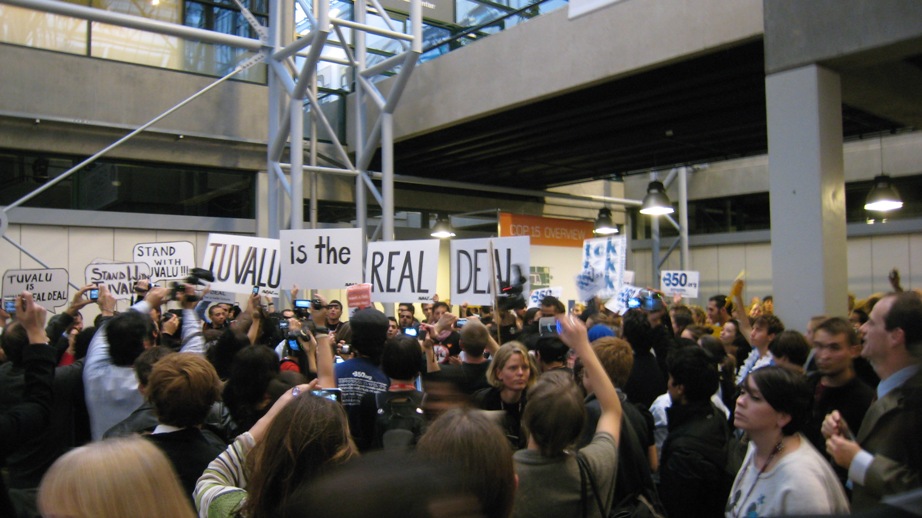
Tuvalu
If you’ve been gripped with Tuvalu fever after their passionate call for a binding agreement on developing country emissions, but you don’t know where to turn for updates that put it in context, then I recommend checking The Green Leap Forward. Those kids are staying on top of things and are attending the all-important press briefings.
Mayor Miller
 The mayor of Toronto, David Miller, was on hand today to accept the second of Canada’s two Fossil awards. For the first time in history, a country was awarded two of three Fossil podium spots. Canada has the distinction of being that country as it took 1st and 2nd place. The EU pulled up the rear with a third place showing.
Canada’s two faux pas were explained by Climate Action Network as (a) proposing an emissions target based on science yet considerably higher than the reductions called for the by the IPCC or its Kyoto Protocol commitment and (b) it’s efforts to replace Kyoto with a new agreement.
 Miller stepped up to accept Canada’s first place prize with a speech saying that Canada’s position does not represent Canadians nor its mayors. Further, he has come to Copenhagen to demonstrate that Toronto is positioning itself to be a global climate leader. After giving his speech he was serenaded about the evils of the tar sands to the tune of “My Heart Will Go On.”
If you’ve been gripped with Tuvalu fever after their passionate call for a binding agreement on developing country emissions, but you don’t know where to turn for updates that put it in context, then I recommend checking The Green Leap Forward. Those kids are staying on top of things and are attending the all-important press briefings.
Mayor Miller

Canada’s two faux pas were explained by Climate Action Network as (a) proposing an emissions target based on science yet considerably higher than the reductions called for the by the IPCC or its Kyoto Protocol commitment and (b) it’s efforts to replace Kyoto with a new agreement.

Days 3-4 @ COP15 – Pictures are Worth Thousands of Words


Friday, October 9, 2009
Day 2* @ COP15: Getting My Feet Wet
My first day at COP15 in Hopenhagen was a bit anti-climactic as I still had some serious jet-lag issues and was finishing up some editing for a solar PV report I’m working on with Zizzo Climate Law. We are identifying the barriers to the adoption of rooftop solar projects for the Toronto and Region Conservation Authority. So despite the hangover euphoria of Canada “only” getting third place in the Fossil of the Day Award competition for Day #1, I was in my own little world. Nevertheless, there were some highlights:
- At the opening of the conference, UNFCCC Executive Secretary Yvo de Boer expressed his hope that agreement could be reached on a strong and long-term response to the urgent challenge of climate change.
- A number of countries stepped up their willingness to take on commitments to reduce or limit GHG emissions in recent weeks, generally increasing hope at COP:
- China indicated that it will target an emissions intensity reduction of 40-45% between 2005-2020;
- Brazil has offered to reduce its emissions by 36-39% below a comparable reference level by 2020 including the objective of reducing rainforest deforestation by 80%;
- South Korea has pledged a 30% cut below reference levels by 2020; and
- Indonesia has expressed a willingness to reduce emissions by 26-41% below business-as-usual depending on how much assistance it receives from Annex I countries.
- Copenhagen (renamed Hopenhagen for the purposes of COP) has pledged to be carbon-neutral by 2025 and given the multitude of cyclists and wonderful public transit in place, I wouldn’t bet against them.
- The IPCC held a panel that opened with a fervent defence of the scientists at East Anglia who were at the centre of “Climategate” and the rigorous methods used in arriving at in their reports. Rajendra Pachauri, Chair of the IPCC, drew attention to the criminal nature of the hacking.
Thursday, October 8, 2009
My Copenhagen Justification
Introduction
I have heard that the Danish capital is expected to welcome approximately 17,000 guests to COP15 over the next two weeks. No doubt a clearer picture of participant numbers will emerge as the conference moves forward, but it’s obvious that a lot of people will be travelling here from far flung destinations. (I suppose when one hears that one’s friends are (a) staying in Swedish hotels and (b) sleeping on ships docked in Copenhagen’s harbour, it’s obvious local accommodations are being stretched to their limits by hordes of attendees.) And while there will probably be a few participants who engage in the token long-distance bicycle ride or hike demonstration, many of us will be flying and contributing to GHG emissions in the process. If I take climate change seriously (and I do), how can I justify my own cross-Atlantic excursion as a principled decision?
The scary answer is, that unlike some of the more engaged participants, I may actually have a prima facie relatively weak case. I am not a negotiator or member of a country delegation. I am registered as a delegate of the Canadian Bar Association but we do not even have an articulated organizational objective for attending. In this case, the CBA is basically facilitating the attendance of some of its membership. Nevertheless, I profess at least three reasons for making this trip and I’ll let you decide if any combination of them meets your exacting standards.
I have heard that the Danish capital is expected to welcome approximately 17,000 guests to COP15 over the next two weeks. No doubt a clearer picture of participant numbers will emerge as the conference moves forward, but it’s obvious that a lot of people will be travelling here from far flung destinations. (I suppose when one hears that one’s friends are (a) staying in Swedish hotels and (b) sleeping on ships docked in Copenhagen’s harbour, it’s obvious local accommodations are being stretched to their limits by hordes of attendees.) And while there will probably be a few participants who engage in the token long-distance bicycle ride or hike demonstration, many of us will be flying and contributing to GHG emissions in the process. If I take climate change seriously (and I do), how can I justify my own cross-Atlantic excursion as a principled decision?
The scary answer is, that unlike some of the more engaged participants, I may actually have a prima facie relatively weak case. I am not a negotiator or member of a country delegation. I am registered as a delegate of the Canadian Bar Association but we do not even have an articulated organizational objective for attending. In this case, the CBA is basically facilitating the attendance of some of its membership. Nevertheless, I profess at least three reasons for making this trip and I’ll let you decide if any combination of them meets your exacting standards.
Subscribe to:
Posts (Atom)