Showing posts with label green energy act. Show all posts

Friday, September 30, 2011

Guest Post: Koenig & Consultants Gaze At Future Solar PV Prices

Koenig & Consultants is a boutique management consulting company based in Toronto and Hamburg with special expertise in the area of Renewable Energy. Their work includes traditional consulting around strategy, marketing and communication for renewable energy companies. Each month they provide a "Chart of the Month" for interested clients, colleagues and friends. This is their September 2011 version. You can reach them at info@koenigconsultants.ca.

CHART OF THE MONTH - SEPTEMBER 2011

Price Development of Solar PV, Feed-in Tariffs and Elections

In our last Chart of the Month we claimed that the costs of renewable energy had one direction only: “down, down, down”. This month we’re looking at the consumer end of things. Our chart shows the development of prices for fully installed solar PV systems in Germany and Canada over the last few years. There are two graphs for each country: smaller residential systems (<10kW) aka microFITs and larger systems (> 10kW).


Here are some observations and conclusions:

The general price trend: There is only one trend indeed – down. Germany has been leading that trend which is most likely induced by an incremental and continued reduction of feed-in tariffs. We strongly believe that this trend will continue in the foreseeable future as the technology will advance and the overall efficiency of the technology and the entire industry will increase.

The market and supply effect on price: Solar of course isn’t exempt from global market conditions. In 2007, for example, prices went up due to high global demand for silicon wafers and other components caused by a booming (overheating) world economy.

The prices solar PV owners pay: In 2009 consumers had to pay a premium for smaller systems in Canada. That year the Green Energy and Green Economy Act was launched in Ontario introducing a microFIT rate of 80.2 cents/kWh for small and mostly residential systems up to 10 kW. The providers of systems in the early phases were able to bank in on those tariffs. As more and more competitors enter the field the prices per installed kilowatt capacity are prone to drop significantly in the next few years. Also most residential customers are better informed now and question prices and fees for hardware, service and consulting.

The prices we pay for electricity: Albeit being higher compared with similar feed-in tariff programs around the world for this small system segment, high feed-in tariffs in Ontario were and still are instrumental in attracting Ontarians to a new industry that was previously non–existent. The higher tariffs are, nevertheless, still justifiable due to the local content rules and a lower sun radiation than in most other jurisdictions with similar feed-in tariffs (e.g. Spain or Italy). Currently, the amount of electrical power fed into the grid from microFIT systems has no significant contribution to rising electricity prices for consumers in Ontario. This is a myth and scenario eagerly painted by those presently cashing in on “old energy”.

Crystal Ball I – the future of solar PV in Germany: Prices in Germany have been in free fall over the last years. The phase-out of nuclear power in Germany can have opposite and thus maybe neutralizing effects on prices: Up – as demand for panels, inverters and qualified installers will increase. Down – as the German market will become once again very attractive and increasing efficiencies may be unleashed with increasing government support for solar R&D.

Crystal Ball II – the future of solar PV in Ontario: With renewable energy being a hot topic in the upcoming provincial election in Ontario, one outcome may be easily predicted. The feed-in tariffs for solar PV projects will come down. The question that remains is by how much? The chart presented here proposes that a 10-13% decrease is possible considering that the local market still needs some support. Should the Conservatives axe the feed-in tariff program entirely or reduce the rates beyond that they will significantly damage if not nip this evolving industry in the bud.

Our Conclusion: It requires a healthy combination of market forces at work and a strong political will translated into transparent and reliable policies to keep the prices for all at balance, the consumers happy and the industry growing.

Tuesday, September 27, 2011

Sun Sets on 2nd Annual Solar & Conservation Fair

As mentioned in an earlier post, Wakulat|Law Principal Rob Wakulat teamed up with local Business Improvement Areas in the Etobicoke Lakeshore community and volunteers from the Environmental Planning Committee of the LAMP Community Health Centre to put on a one-day Solar & Conservation Fair dedicated to showcasing sustainability initiatives. A key theme was empowering local communities to explore taking on their own sustainability projects and, in particular, the opportunity presented by community power.

On Saturday September 10, 2011, the Assembly Hall played host to over 20 exhibitors, 13 speakers and over 200 attendees. Event highlights included:

IMG_0245
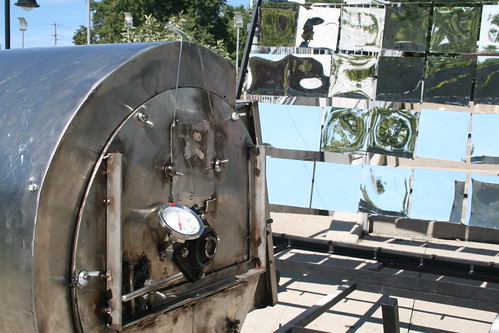
Chocosol Solar Roaster
  • Welcome speech by local MPP Laurel Broten who travelled the province as Minister of the Environment (2005-2007) in support of the legislative and committee process that introduced the Green Energy and Green Economy Act to Ontario;
  • A prototype solar roaster built by Lorin Symington and the Chocosol team used to roast cacao beans for onsite sampling;
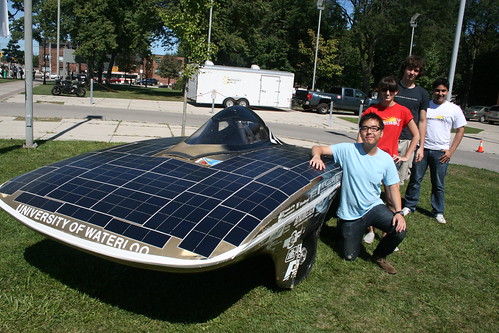
  • The University of Waterloo's Midnight Sun Solar Race Team with last year's solar car used for competing in international solar car competitions;
  • Local business owner Jim McNeil explaining why he decided to make Canclone Services the first solar-powered printer in Toronto; 
  • Information from speaker Matthew Zipchen about the recently launched SolarShare initiative which allows any Ontarian to invest in $1,000 community solar bonds, with a 5-year term and 5% annual return;
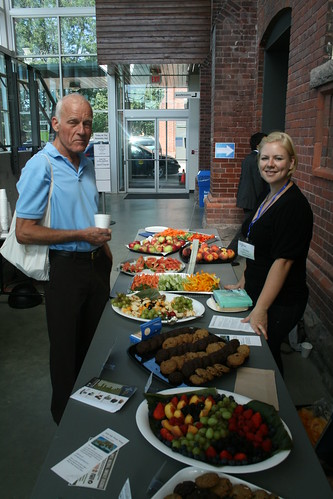
  • Samples of generously donated organic and locally-sourced refreshments from Front Door Organics, The Village Butcher, Fresh City Farms and Social Coffee & Tea Company; 
  • Book signing by author, columnist and Cleanbreak blogger Tyler Hamilton for his new book Mad Like Tesla; and
  • IMG_0251
     University of Waterloo Midnight Sun Solar Race Team
  • Environmental author and speaker Jim Harris delivering the end-of-day keynote speech that explained how going green is good for business.
The Fair encouraged people who not only care about reducing their environmental footprint to gather and discuss ideas, but also those people interested in learning about how to benefit financially from taking on green initiatives. Attendees were able to check out seminars on topics such as rooftop solar technology, community power, green careers and energy conservation through landscaping. Exhibitors provided insight into their sustainable food options, solar technology, and community capacity building.

IMG_0235
The donated delectables.

Even though Ontario has implemented the Green Energy and Green Economy Act, not all communities have easy access to the knowledge and tools required to participate in this emerging sustainable economy. The event was designed to bring useful information to businesses, residents and community groups who are normally quite busy and don’t necessarily have the time to research how they can participate in the province’s emerging green economy.

The Fair was an example of community spirit, created and planned with the participation of local business associations, dedicated volunteers and non-profit community groups who share a passion for a cleaner, healthier and prosperous future.

Key support for the event was provided from the local BIAs, TABIA, Bullfrog Power and Toronto Hydro.
IMG_0260
Event sponsor Toronto Hydro with materials promoting energy efficiency.

Saturday, September 24, 2011

Wakulat|Law Supports Friends of Wind's Public Outreach

Introduction
Ever since the Province of Ontario introduced its landmark Green Energy and Green Economy Act, two major tracks of criticism have bedevilled the wind sector. First, developers are more likely to find local communities opposing proposed wind farms that have taken advantage of the streamlined approval process implemented by the Act. This lack of required consultation has created a sense of helplessness as rural residents feel large numbers of turbines are erected without regard to their visual or health concerns. This has stirred an emotionally divisive debate across the province's countryside that has proven grist for the government's political opponents in an election year.

The Impact on Health
While beauty is in the eye of the beholder, it should be an easier task to address health concerns with facts and research.  Earlier this year, Toronto-based environmental lawyer Dianne Saxe reported on a full-day webcast - Wind Power & Human Health Scientific Forum - dedicated to discussing wind power effects on human health.  The conclusion was essentially that "infrasound from wind turbines is not a health problem." This accords with an earlier report from Dr. Arlene King, Ontario's Chief Medical Officer of Health, who concluded that there is "no direct causal link between wind turbines and adverse health effects." Naturally, health professionals and wind proponents should take any concerns raised by residents seriously, but reasoned debate should be expected from all sides and include an understanding of the established facts to date.

Friends of Wind
Earlier this month Wakulat|Law had the privilege of participating in a public forum organized by a nascent grassroots group: "Friends of Wind". The group's research has indicated that "public opinion polls have consistently shown the majority of Canadians support wind energy for its environmental, economic and social benefits". They became concerned that this point-of-view was being lost to the more vocal groups bringing wind development into disrepute. Led by a full-time farmer and mother of four, Jutta Splettstoesser, Friends of Wind decided to put on four public events where industry experts could share the facts with interested residents, citizens and policymakers.

Jutta has been supported in her efforts by like-minded individuals and wind energy industry leaders keen to ensure all citizens can “join the conversation” about Ontario's energy future. Their fourth and final event was held on September 8, 2011 in London, Ontario. Wakulat|Law Principal Robert Wakulat moderated a panel that included the following expert speakers:
  • Gideon Forman, Executive Director, Canadian Association of Physicians for the Environment
  • Paul Seccaspina, CEO of Oraclepoll Research Limited
  • Horia Hangan, Director of University of Western Ontario Wind Tunnel & Project Lead WindEEE
  • Vinay Sharma, CEO, London Hydro
Forman, as he has done in the past, tackled the health issue and asked attendees to consider the health impacts of alternative generation options such as nuclear and coal. Seccaspina provided detailed insights into the minds of Ontarians with a focus on their attitudes towards renewable power and the upcoming provincial election:

Friends of Wind_Sept7

Friday, September 23, 2011

Ontario Votes 2011: The Future Of Energy Policy

Introduction
Energy has become a hot topic during the Province of Ontario’s 40th election campaign. Hydro bills, the smart grid (read: time-of-use pricing) and the energy fuel mix are all issues that have animated the policy positions of the four main parties as voters prepare to head to the polls on October 6, 2011. The debate surrounding the province’s renewable energy sector has created uncertainty about the future of the Green Energy and Green Economy Act (Ontario) and the Feed-in-Tariff programs. Proponents have hailed these regulatory features as world-class achievements, while others have criticized them as unfair and expensive subsidies.

In the two years of the FIT programs, Ontario has made significant progress. The province has over 90 projects operational with a nameplate capacity of over 24MW. By comparison, it takes on average of 60 months to construct a nuclear plant, from pouring the first concrete to putting power on the grid. This does not include the time needed to plan; complete environmental assessments and public consultations; obtain permits and licenses; or design, manufacture and finance it. These activities all add to the time before a nuclear plant will turn on a single light bulb.

The Parties Speak
One of the more recent high profile attempts to understand the panoply of policy choices facing Ontario’s voters was a gathering of the key energy representatives of each major political party on TVO’s The Agenda with Steve Paikin. On September 7, 2011, Paikin’s episode The Debate: Energy and the Ontario Election featured Ontario Energy Minister Brad Duguid, PC Energy Critic John Yakabuski, NDP Energy Critic Peter Tabuns, Ontario Green Party Candidate Steve Dyck, and energy analyst Steve Aplin.

Just as helpfully, the Ontario Sustainable Energy Association took the month of August to put together a similar roster of party representatives (only switching out Dyck with GPO Leader Mike Schreiner) to address issues such as renewable energy, conservation and community power more specifically. In a series of one-on-one web interviews, OSEA Executive Director Kris Stevens asked each party about their positions on the preceding issues.

Blackout – The Conservatives Remain Mum
Unfortunately, after interviewing Duguid, Tabuns and Schreiner, Stevens was forced into sending out a public letter to the OSEA community announcing that Conservative energy critic John Yakubuski had withdrawn from participating in the interviews. Stevens explained that Yakabuski’s office had indicated several months ago that Yakabuski would participate in a session. However, after weeks of delays, further promises of participation, offers on Steven’s behalf to travel to the riding of Renfrew-Nipissing to interview Yakabuski and a variety of other efforts, the Conservative candidate cancelled his participation. As Stevens' put it:
Silence sometimes speaks louder than words. We are left to assume that the Conservative party has no plan for conservation, community-based renewables, the private sector or manufacturing beyond killing what has been heralded as the most progressive energy policy in North America.
It is with deep gratitude that this blog can post the work of OSEA volunteer (and occasional Wakulat|Law guest blogger) Neil Fairhead who put together and shared the following summary of the three parties who participated in the OSEA interview process. The party positions appear in alphabetic order: Green Party, Liberal Party, and NDP. 

Green Party - Conservation, Efficiency and Community
Mike Schreiner, Party Leader, laid out an approach to energy for Ontario that places an emphasis on efficiency, conservation and the involvement of local communities.

Schreiner stated “no more investment in nuclear” since the average overrun on nuclear projects has been five times the original budget. This money would be better spent on conservation where half the cost would save the same amount of power and create nine times the jobs - retrofitting current housing, insulation and providing solar thermal heating of domestic water.

He also emphasized the need to get much closer community involvement. In particular, the benefits of renewable power must be shared locally. In Germany, over 200,000 people have equity stakes in local projects. This local involvement is essential to balancing the interest of local communities with the broader needs of the whole province. To achieve this, the Green Party will ensure community access to capital and priority access to the grid. They will also focus on energy education, for both consumers and workers.

The Green Party's priorities are:
  1. A programme on energy efficiency and conservation - “Reduced bills, same lifestyle”.
  2. Revise the FIT process, focusing on communities so they invest more and they benefit more - financially with revenue and economically with jobs.
  3. A new long-term energy plan with a broader supply mix including more combined heat-and-power, renewables and hydro - from Quebec and Manitoba as well as Ontario. The plan would include a budget so that businesses can invest in Ontario knowing they will have reliable, affordable energy.
Liberal Party - Green Energy Is Good for Ontario and for Ontarians
Minister Duguid, outlined a vision of Ontario based on four pillars:
  1. A healthier environment for children as coal burning power stations are phased out;
  2. A healthier electricity system that has not suffered brownouts nor blackouts nor needed large imports of high priced power this year - despite the record heat wave;
  3. A healthy job market that has already bounced back from the recession, thanks in large part to 20,000 new jobs in clean energy - the rest of the economy remains fragile;
  4. A healthier climate for investment - $20 billion have already been invested in the new green economy in Ontario.
The Liberal Party believes that it must balance the need to invest in the Province's ageing transmission and generation infrastructure, with the need to help households by minimizing rates such as the current 10% green energy rebate. Investing in conservation also helps households since the cheapest watt is the one we do not use. The Liberal Government has doubled the expenditure of its predecessor and believes this must continue as there are key improvements required to ensure a reliable, efficient and non-polluting supply of energy. These investments include more storage, a more flexible grid and meters that encourage ratepayers to use electricity when there is spare capacity and to reduce their usage at times of high demand.

The Liberals recognize that some changes are required and Duguid specifically highlighted the role of municipalities: “Municipal engagement is mandatory and, while the government is working to streamline the process, it will remain mandatory.” He also highlighted the value of using the same energy for both power generation and for heating through the use of combined heat-and-power plants. Finally he stated that the price paid for electricity from renewable sources will have to come down and that they are looking at price reduction milestones. However, he noted that the costs of production, such as solar panels, are already coming down which will enable the price reductions while still rewarding investment. The research going on in Ontario will help to drive the costs down further.

In short, the Liberal Party believes that their commitment to green energy has been good for Ontario and we should persist with it - to provide a cleaner, more healthy environment for our children and a more prosperous, clean energy based, economy. 

NDP - Waste Not Want Not
Energy Critic Tabuns started with three key points:
  1. The province's current approach places too little emphasis on efficiency and conservation;
  2. Nuclear power consistently goes over budget creating large cost overruns to be paid by the taxpayer or the customer. The current assumption that nuclear remains the source of half of our power needs to change.
  3. The partial privatization of our electricity system has resulted in “hundreds of millions of dollars being paid to energy traders and producers who game the system.”

The NDP put much greater emphasis on efficiency and conservation. They stand for minimizing usage through less waste and greater efficiency; and then supplying much of what is needed via renewables. There are challenges in doing this. Our 20th century system is highly centralized: big nuclear plants, coal plants, hydro plants - and networks that move power outwards. The 21st century system is more dispersed. We need a distribution system to match if we want to keep up with the leaders. Ontario has rested on investments made in the 20th century such as at Niagara Falls. Now we need to invest for this century but new/renovated generation capacity is high cost compared to increasing efficiency and conservation. We need to do both together to deliver the affordable reliable power, which will create the political support needed to make this change. The energy system is a major determinant of income and productivity in Ontario. If we fall behind it will be difficult to catch up.

The NDP energy platform for the upcoming election has two main thrusts:
  1. Conservation: avoid waste with increased efficiency to make the best use of the power consumed. This includes focusing on energy retrofits of buildings where much energy is wasted and on the Energy Star programme, improving the efficiency of appliances, etc.
  2. A balanced approach to energy supply: the environment must benefit and so must the economy with all sources rigorously assessed for costs and benefits. Given the disaster at Fukushima, nuclear costs will increase as more safety factors are addressed. The NDP will not rebuild the Darlington nuclear plant, using the funds saved elsewhere including retrofitting housing. Green energy will grow in significance but only where the costs and benefits justify it.
Conclusion
The future of Ontario’s energy policy is at stake in this election. In the last few years, the province has become home to some of the most exciting clean energy projects in the world, like the world's largest solar photovoltaic farm in Sarnia and Canada's largest rooftop solar installation in Windsor. Ten wind turbines in 2003 have sprouted to more than 900 turbines and counting. And people who used to work at automotive plants are now building these solar panels and turbines.

While the PC Party is not making its energy policies as accessible to voters as the other parties, it is reasonable to conclude its approach would diverge significantly from support of the Green Energy and Green Economy Act. Their approach could kill some of these new energy jobs, stall innovation and increase dependence on dirty energy sources that contribute to asthma, lung disease and premature deaths.

Building an innovative economy for the 21st century requires risk-taking and comprehensive planning. Doing so effectively will enable Ontario to be a major international player in the trillion-dollar clean energy industry blowing around the world.

Monday, August 15, 2011

Wakulat|Law Organizes 2nd Annual Solar & Conservation Fair on the Lakeshore

Following on the heels of last year's first go-round with the Solar & Conservation Fair on the Lakeshore, Wakulat|Law has become involved in organizing a second iteration of the event.  On Saturday September 10, 2011, the 2nd Annual Solar and Conservation Fair will be hosted by the local Lakeshore Business Improvement Areas. It will take place at the Assembly Hall in South Etobicoke from 11 am to 4 pm. This one-day community event will feature exhibitors, vendors and speakers on topics related to renewable energy, conservation and environmental sustainability. The event is open to residents and businesses. Admission is free.

The Fair is an opportunity for people who not only care about reducing their environmental footprint, but also want to learn how to benefit financially from taking on green initiatives. Last year, the emphasis of the Fair was on solar education. This year it is expanding in scope to meet the broader interests and needs of the community. Attendees can go to seminars on topics such as residential rooftop solar technology and community power, speak to exhibitors who are providing sustainable food options and solar technology, find out about green career opportunities, sample locally-sourced refreshments and learn how to build a community power project.

Not all communities have easy access to the knowledge and tools required to participate in this emerging sustainable economy. Small business owners and residents are busy and don’t necessarily have the time to research how they can participate in the province’s emerging green economy. This type of event is designed to bring them that information and make it more accessible to businesses, residents and community groups.

The Fair itself is an example of community spirit, created and planned with the participation of local business associations, dedicated volunteers from the LAMP Community Health Centre and non-profit community groups who share a passion for a cleaner, healthier and prosperous future. It offers members of the community the opportunity not only to learn about alternative energy from industry leaders, but also from each other. The Fair will also help the local economy by featuring several local business, giving residents the opportunity to directly support their neighbourhood business owners.

This project has received funding support from the Ontario Power Authority through the Community Energy Partnerships Program. Such support does not indicate endorsement by the OPA or the Province of Ontario of the contents of this material. The views expressed in the material are the views of the Recipient and do not necessarily reflect those of the OPA or the Province of Ontario.

Saturday, June 4, 2011

Strengthening Community Bonds to Build a Greener Future

Engaging the public in significant initiatives by issuing bonds has a long history in Canada, arguably originating with the war bonds used to finance the country’s early 20th century war efforts. Today, rather than using the proceeds of bonds to tear down a foreign enemy, they are being put towards the building of local communities.

CSI's Community Bonds

The Toronto-based Centre for Social Innovation (CSI) recently demonstrated how reaching out to the broader community has enabled it to expand on its mission of catalyzing and supporting new ideas to change its community. The original CSI building at 215 Spadina Street (CSI-Spadina) created shared workspace in downtown Toronto for over 200 members working at organizations with a social mission. CSI-Spadina provided them with a means to connect, learn and exchange ideas in a professional setting. This also provided CSI-Spadina tenants with a platform to engage their stakeholders and the community beyond the walls of their new home.

Friday, May 20, 2011

Guest Post: Koenig & Consultants Inc. Busting Renewable Energy Myths

Koenig & Consultants is a boutique management consulting company based in Toronto and Hamburg with special expertise in the area of Renewable Energy. Their work includes traditional consulting around strategy, marketing and communication for renewable energy companies. Each month they provide a "Chart of the Month" for interested clients, colleagues and friends. This is their May 2011 version. You can reach them at info@koenigconsultants.ca.

CHART OF THE MONTH - May 2011
Nuclear vs. Renewable Energy – Two Myths and the Reality

After the disaster at the Fukushima I plant in Japan a heated discussion over nuclear power and renewable energy has resumed. Before the accident, nuclear power was almost “green” due to being a non-GHG emitting form of energy – and it probably still is at least in comparison to fossil fuels. Nevertheless, the two most significant pro-nuclear power arguments in comparison to renewable energy have usually been that:
  1. it is more reliable; and
  2. it is cheaper,
With this Double Chart of the Month we would like to bust these two myths.

Source:  Paul Gipe at http://www.wind-works.org/
Chart #1 (reprinted with permission from Paul Gipe (wind-works.org)) compares Fukushima I with the wind energy production of Germany, Spain and Denmark over the last twenty years. Clearly, wind turns out to be more reliable than the nuclear. When taking a closer look at the individual reactor blocks at Fukushima I (there are six), it gets even worse. If one wind turbine needs to be shut down for maintenance … who cares? If a nuclear power plant goes out, an entire region can be in trouble.

Chart #2 addresses the price myth. Comparing the different energy forms on a fully costed basis including all costs (generation costs, government subsidies, and also external costs) as a recent study has done, reveals that nuclear power is almost twice as expensive as hydro or wind power. Solar power is still more expensive but that is rapidly changing.

The situation in Chart #2 is somewhat special to Germany with its high subsidies for nuclear and high productivity of wind. However it is clear that a similar picture will develop in other economies in the near future: There is only one direction for the development costs of traditional forms of energy encompassing longer approvals, higher fuel prices, more safety requirements and leveling off of productivity – up, up, up. For renewable energy, the opposite is true. There are huge gains to be found in the efficiency and productivity of production, approvals and free, unlimited fuel. These costs also have only one direction – down, down, down.

A small example from Ontario should illustrate this: 18 months ago, when the Green Energy and Green Economy Act was introduced, a 1kW solar PV installation on a residential house was quoted for ~$12,000. Now, anybody paying more than $ 6,500 is certainly overpaying.

Thanks Ingo, Christine and the KCI Energy Team!
~ Rob 

Tuesday, May 3, 2011

Guest Post: Daniel Bida and Ontario's Biogas Market

Daniel Bida is the founder of ReGenerate Biogas, a company created in in early 2009 to foster the development of community-owned anaerobic digestion for agriculture around Ontario. Daniel has kindly shared his thoughts on the progress of the Ontario biogas market with this post.

I’m currently reading Roger Martin’s The Design of Business – a business book examining the way organizations make use of and organize knowledge to drive growth and longevity.

Moving Down the Funnel


Knowledge, it says, moves through three phases as it goes down the funnel, from the general to the specific: Mystery –> Heuristic –> Algorithm. This got me thinking about what stage the Ontario biogas industry is in, and what stage I myself am in developing community-owned biogas plants.
Biogas Plant, Pucking, Upper Austria

At the mystery phase (which Ontario was in around 2005), there are lots of facts available, but making sense of the right ones to create value is more of a challenge.  Biogas companies at this time were mostly traveling to Europe to learn from companies and communities there, and trying to figure out the best sources and combinations of feedstock in the Ontario market. They were able to come away with some inspiring examples of success such as the pilot project in Pucking, Upper Austria, which supplies the existing natural gas grid with biogas upgraded to natural gas quality. Unfortunately, the myriad of government support programs offered in Europe for these innovations did not exist in Ontario at the time. Greatly adding to local mystery was (and is) the ever-changing regulatory market, which has caused many of us to re-examine our original assumptions and attack the market in a different way.

At the heuristic phase (which Ontario has been in since about 2007), some rules of thumb have been developed – helping the industry narrow down which farms are most suitable, which feedstocks and recipes are ideal, which digester technologies work best, what size plants are most suitable, how to handle complex feedstocks (curbside organics), how to work with local stakeholders, how to speed up permitting and approvals, and how to turn a profit (sometimes). We are relying on these early rules of thumb in an effort to increase efficiency, thereby growing our businesses and the industry.

At the algorithm phase, a highly scalable formula is established and replicated hundreds or thousands of times over, greatly increasing efficiency and the total number of biogas plants from the current number (less than 50) to its full potential (between 500 and 1,500). No firms have yet entered this phase I believe, but we are very close.  Knowledge and understanding of the technology is up. Investors and lenders are taking notice. Numerous projects are up and running, some successfully, some not – providing valuable lessons to developers. (can we highlight the Niagara project?)

Stopping the Flow

The major obstacle at this point is largely political.  We are faced with continued long-term uncertainty – even short-term certainty isn’t a given at this point. The best thing the provincial government can do in the Fall of 2011l (whoever they happen to be after the election), is to establish strong protocols and practices that can stand the test of time – and then sit back and watch as the Ontario biogas industry diverts organics from landfills, reduces greenhouse gas emissions, produces better than commercial grade fertilizer, generates  readily dispatchable renewable power, and provides direct financial support to farmers.

Resources

In addition to the services of ReGenerate, parties interested in learning more about biogas opportunities in Ontario can check with these organizations:

Thanks, Daniel!
~ Rob

Friday, April 22, 2011

California Raises the Renewable Energy Stakes

While the political opposition in Ontario continues to question the value of the province's Feed-in Tariff Program, the state of California has bet the windfarm on renewable energy. Last week, Governor Jerry Brown upped the ante by signing legislation which would require California utilities to get one-third of their power from renewable sources. This creates the most aggressive alternative-energy mandate in the United States.

Senate Bill 2 (SBX1 2) will extend the current 20% renewables portfolio standard target for 2010 to a 33% renewables portfolio standard by December 31, 2020. The former version had targeted investor-owned utilities such as Southern California Edison, Pacific Gas & Electric and San Diego Gas & Electric. The new law will also apply to municipal utilities such as the Los Angeles Department of Water and Power and the Sacramento Municipal Utility District, which manage about a quarter of the state’s electricity load.

The new mandate will also require utilities to draw some of their power from small local projects based near customers (i.e. distributed generation). This would include generation from rooftop solar PV or small wind. The full text of the bill can be viewed here.

Industry cited the long-term stability provided by the law as integral to moving away from the boom-bust cycles of renewable energy markets often dependent upon short-term government incentive programs. Russ Kanjorski, a vice president at Abound Solar, was quoted in the Los Angeles Times as stating, "The RPS requirements allow utilities to plan to meet higher renewable energy standards and orient the market towards meeting those goals."

Ontario's Green Energy and Green Economy Act and FIT Program were attempts to put in place a stable investment climate for business, which would create viable conditions for the development of a domestic renewable energy market. Of course there are valid concerns about aspects of an initiative as comprehensive as the GEGEA. That's why the government included a regular review period of the FIT Program. As a provincial election approaches in the Fall of 2011, Ontarians will have their say on whether to double down on the current strategy or fold and hope the Californias of the world are left holding a bad beat.

Sunny Days
~Rob

Tuesday, April 5, 2011

Partners in Project Green Discusses Economics of Rooftop Solar

As mentioned in an earlier post, Wakulat|Law worked with Zizzo Allan Climate Law to co-author a report entitled Barriers to the Adoption of Rooftop Solar for Partners in Project Green which is a project being operated in the Pearson Eco-Business Zone.

PPG comprises approximately 12,000 hectares in the Greater Toronto Are, including Toronto Pearson International Airport as well as portions of the Region of Peel, City of Toronto, City of Mississauga and City of Brampton. More than 12,500 primarily small and medium-sized businesses employing over 350,000 people call the Zone home. PPG's main objective is to improve these business' financial and environmental performance through more efficient resource use.

The scale of potential savings in the Zone is significant. An assessment of the current energy-use in the Pearson Eco-Business Zone was completed. A 2007 annual assessment reviewed all non-process energy requirements, which were estimated at 5,801,000 MWh of total electricity consumption and 46,447,000 GJ in natural gas consumption in 2007.

Since the solar barrier report's publication in May 2010, PPG has aggressively worked with its stakeholders to advance the Zone's understanding of Ontario's green energy regulatory framework and the opportunities and risks of implementing rooftop solar photovoltaic projects.

This past March PPG brought together a number of local businesses to further delve into these issues. The sessions included an overview of the Ontario Feed-in Tariff program and approval process for renewable energy projects, along with identifying technical considerations that could impact the economics of rooftop solar projects. A few project proponents also shared their experiences with installing rooftop and ground-mounted solar installations at their facilities.

The following presentations are now available for viewing on the Partners in Project Green website:
~ Rob

Monday, January 31, 2011

Ontario Powers Ahead: Draft Rules Posted for CHP & CESOP

As mentioned in a previous post, the Ontario Power Authority (OPA) announced its intention to move forward with two exciting initiatives:
  1. individually negotiated Combined Heat and Power (CHP) projects greater than 20 MW in capacity; and
  2. Clean Energy Standard Offer Programs (CESOP) for:
    • up to 150 MW of new CHP using natural gas-fired electricity generating facilities of 20 MW or less, under the Combined Heat and Power Standard Offer Program (CHPSOP), limited to cost-effective projects located in areas of the province where they can be accommodated in the local distribution system and where there are local benefits; and
    • up to 50 MW during the launch period of new energy recovery facilities under the Energy Recovery Standard Offer Program (ERSOP) to support efficient generation of electricity from recovery of otherwise wasted energy sources, such as unutilized by-products that can be used as fuels. The ERSOP Program's objective is to facilitate increased development of energy recovery facilities up to a maximum capacity of 20 MW.
The OPA's draft program rules and contract were posted here today. The process for stakeholder engagement and to finalize development of the CHPSOP and ERSOP is as follows:
  1. draft program documents to be posted on the OPA website for stakeholder review;
  2. consultations to be held with stakeholders;
  3. defined period for written comments from stakeholders to be submitted to the OPA;
  4. defined period for OPA review of submissions;
  5. final program documents to be posted on the OPA website; and
  6. program launch.
 Activity  Date
Posting of draft program rules and contract  January 31, 2011

Stakeholder Consultations
  • Stakeholder question and comment period
  • Stakeholder sessions
January 31, 2011 – March 11, 2011 Formal stakeholder sessions to be held in late February – early March. Specific dates for these sessions will be announced in early February.
OPA review of stakeholder comments and submissions & posting of final program documents  March - April
 Program launch  Q2 2011

CHP Trailblazer

At least one enterprising partnership has already positioned itself to take advantage of the new regulatory framework. Guelph Hydro Inc. has signed an agreement in principle with Dalkia Canada to develop three CHP/District Energy projects representing 28 MW of clean local power generation. They are meant to move the City of Guelph closer towards achieving the objectives of its revamped Community Energy Initiative.

CHP Benefits

CHP is the simultaneous generation of usable heat and power (usually electricity) in a single process using proven and reliable technology. Otherwise excess heat is harnessed and distributed to buildings as hot water or steam via underground district heating pipes. During the summer, the use of absorption chillers allows cool water to be fed through the pipes to increase cooling capacity.

Ryaverket, CHP plant in Borås, Sweden (Photo: Ulf Nilsson)
When electricity is generated at large, centralized power stations, a considerable amount of the primary energy in fuel is simply wasted as heat exhausted into the atmosphere. Use of the heat produced during electricity generation in a CHP system allows them to achieve overall efficiencies in excess of 80% at the point of use. The efficiency of a conventional coal-fired power station, which discards a significant amount of heat to atmosphere, is typically about 38% at the power station. Efficiency at the point of use is further reduced because of losses that occur during transmission and distribution.

The high level of efficiency also provides important environmental benefits. For every unit of energy (heat or electricity) produced by a CHP plant from its input fuel, the levels of carbon dioxide, oxides of nitrogen and sulphur dioxide emitted are less than half of those associated with a conventional coal-fired power station.

Sunny Days,
~Rob

    Friday, January 14, 2011

    Canadian Lawyer Magazine Cites Wakulat|Law Concerns Regarding Solar Access

    In its latest issue (January 2011), Canadian Lawyer Magazine helps to shine some light at the black hole that is currently the Province of Ontario's solar access regulatory framework. Paul Brent, the article's writer, cited my research on this topic to point out there continues to be some confusion at which level of government this issue may be addressed. Brent writes "While Wakulat says it would be logical for right-to-solar issues to be handled at the local level by municipalities, Ontario's Green Energy and Green Economy Act has, in fact, taken away much of the planning authority from local governments." This essentially puts the onus on the provincial government to ensure solar investments aren't rendered an expensive set of roofing shingles.

    Brent also undertook some very helpful additional research in order to illuminate a case that made its way to the Ontario Municipal Board and included a "right to light" as one of the many issues facing a developer's application to amend a zoning bylaw. While the article is not available online, I have reprinted a copy below:

    Canadian Lawyer - Solar Access

    One caveat is that since originally discussing the issue with Brent, I can confirm that solar access is now being raised as a potential issue at the development stage of some projects. While I have not yet heard of a project being abandoned because of this concern, industry participants are taking the issue seriously where potential neighbouring development could increase system shading.

    For anyone interested in a succinct but very helpful overview of the loss of municipal authority under the Green Energy and Green Economy Act, I highly recommend this article by Paul Manning of Manning Environmental Law and Joanna Vince. It's entitled Municipalities and the Green Energy Act Update: Benefits, Burdens and Loss of Power.  It appears in the January 2010 issue of Municipal World.

    Sunny Days,
    ~Rob

    Saturday, December 18, 2010

    Ontario Moving Forward with Combined Heat and Power

    The Ontario Power Authority (OPA) has recently provided updates on its progress towards integrating 1,000 megawatts (MW) of Combined Heat and Power (CHP) into Ontario's electricity system. During its management teleconference and webcast on December 3, 2010, the OPA indicated it was on track to introduce draft rules on a feed-in tariff (FIT) program for CHP projects under 20 MW. It has followed that up by publishing this update on its website.

    Ontario's energy industry has been aware of the value of CHP for some time, but the desire to incorporate this technology into existing infrastructure has only recently picked up some serious steam. The OPA previously procured and developed CHP projects such as Markham District Energy, Durham College District Energy and the London Cogeneration Project. Since it is currently managing contracts that represent more than 450 MW of CHP-based technology procured through past initiatives, this leaves approximately 500 MW for additional projects.

    To better understand how to develop and integrate these projects, the province's Electricity Distributors Association (EDA) coordinated a fact-finding tour to Denmark in the summer of 2009 for a number of its members. A video of the EDA excursion can be viewed here.

    The EDA's choice of Denmark was an inspired one because of the leadership demonstrated by Danish cities such as Copenhagen which use CHP to supply 97% of the city with heating. The Copenhagen district heating system is one of the world's largest, oldest and most successful. It was set up in 1984 to capture waste heat from garbage incineration and CHP plants - normally released into the sea – and channel it back through pipes into residents' homes.  The system has cut household bills by 1,400 EUR annually, and saved Copenhagen the equivalent of 203,000 tons of oil every year thereby reducing CO2 emissions by 665,000 tons.

    The current push by the OPA to develop CHP emerged from a Ministerial directive on November 23, 2010.  It instructed the OPA to continue to individually negotiate CHP contracts for projects over 20 MW, while implementing the FIT program for anything under 20 MW while limited to "cost-effective projects located in areas of the province where they can be accommodated in the local distribution system and where there are local benefits."

    Interested parties can visit the OPA CHP update page to sign up for updates or get more information from the OPA.

    Friday, November 5, 2010

    Community Power Developments in Canada

    Background  

    In a previous post, I discussed the importance of embedding acceptance for the objectives of Ontario's Green Energy and Green Economy Act (Ontario) (the "Act") within communities. Only by developing widespread support for renewable energy would the province be able to ensure enough support is entrenched to weather future storms and transfers of political power.  Recent developments suggest the province is on track to incorporating local communities in this transformative change.

    Ontario's Track Record

    Developing community-owned renewable generation is an objective of the Act and a major goal of the Feed-in Tariff ("FIT") Program. Early reviews of the effort by the Ontario Power Authority ("OPA"), which administers the FIT Program, suggest it is realizing some considerable headway in this regard. It has signed contracts for 264 MW of community renewable generation and an additional 120 MW from Aboriginal renewable generation according to an October 12, 2010 report.

    Energy analyst Paul Gipe has stated that once these projects are completed, "Ontario will have the largest installed base of community-owned renewable generation in North America, surpassing community ownership of renewable generation in Minnesota." This could put the province on track to have the largest installation of community-owned renewable generation outside of traditional powerhouses Denmark and Germany. However, there is still a palpable sense of uneasiness among the sector's most enthusiastic supporters who see limited financing options and low returns as two significant barriers for these groups to overcome.

    Thursday, November 4, 2010

    Wakulat | Law to Participate at Power Conference

    Thanks to the jolt provided by the passage of Ontario's Green Energy and Green Economy Act last year, a variety of newcomers have taken on leadership roles in bringing clean, green and distributed energy to the province.  Chief among these varied groups is the Ontario Sustainable Energy Association, which is a province-wide, member-based non-profit organization dedicated to supporting the development of Community Power projects and renewable energy. It includes an eclectic membership of private citizens, cooperatives, farmers, First Nations, businesses, institutions, consultants and municipalities.  Though not necessarily a "newcomer" since OSEA was a key member of the Green Energy Act Alliance, it has most definitely expanded its role and influence since the Act was introduced.

    OSEA is also responsible for putting on the only Community Power-focused conference in Canada, if not the world.  The second annual Community Power Conference will take place November 14-16, 2010 in Toronto, Canada.  It will bring together approximately 600 delegates from the above-mentioned groups along with a selection of international speakers and participants from such places as Australia, Brazil, Denmark and Japan.  One of these special guests includes Fabio Rosa, who is a Brazilian social entrepreneur focused on promoting rural electrification and the use of sustainable energy sources. His inspirational story was featured earlier this year on PBS' series The New Heroes:


    I am a proud supporter of OSEA and in order to demonstrate my commitment to grassroots energy generation, I have dedicated at least two days per week since mid-August to volunteering with the amazing folks planning the conference.  The commitment and passion of OSEA staff, volunteers and advisors has given me hope that despite the learning curve and challenges of developing community power in Ontario that progress will continue to be made.

    Our communities are already benefiting from ground-breaking work by groups such as the Toronto Renewable Energy Co-Operative, Pukwis Energy Co-op and the Neighbourhood Unitarian Universalist Congregation, to name but a few. They have demonstrated despite the imperfections of the current Green Energy Act and Feed-In Tariff Program, that successful Community Power projects are possible in Ontario.

    Thus, it is with great pleasure that I will be participating with OSEA's co-organizer, the Association of Power Producers of Ontario as a moderator for a panel in their Power Networking Centre.  APPrO is holding its conference alongside OSEA which will be the 22nd Annual Canadian Power Conference. It will take place on November 16-17, 2010 and its theme is Making Green Sustainable: Responsibly Rebalancing the System.

    If you would like to work with these groups or attend the conference, please contact me and I can plug you into the right people.  It is only by working together and supporting one another that we will truly embed an ethic of conservation and renewable generation in our communities.

    Thank you,
    Rob

    Tuesday, November 2, 2010

    Ontario's Solar Incentive Cutbacks: FITting in the Bigger Picture

    Earlier this year, the provincial Government of Ontario came under heated criticism when its industry regulator, the Ontario Power Authority, abruptly proposed a rate cut to its microFIT (Feed-in Tariff) program. Coming just nine months after the program launch, the proposal was to scale back the tariff rate for ground-mounted solar PV installations from 80.2 cents per kWh to 58.8 cents per kWh. After a month-long consultation process in which industry proponents argued vociferously against the move, the Ontario Power Authority compromised and settled on a rate of 64.2 cents per kWh while essentially banning the practice of commercial aggregation under microFIT.  

    There was considerable concern that the OPA's process as opposed to the actual decision could serve to  undermine investor confidence in the province's much-larger FIT program designed for big producers of energy from sources like the sun and wind. However, it is interesting to note that the OPA decision fits a wider trend affecting FIT programs on a global scale. Presumably still recovering from the Great Recession, many other governments have also reconsidered their financial commitment to renewable energy generation.  Some in a much less adroit manner than Ontario.  For example:
    • Germany:  Both the leading exemplar of how to develop a FIT program and also perhaps how to make effective adjustments on the fly, the government is teaching the German solar industry how to adapt to a much less lucrative home jurisdiction. Following an intense political debate, the German Bundestag decided to invoke a mid-year reduction to its solar FIT program. By early July politicians had agreed on a two-step reduction, with reductions taking place on July 1 and October 1, 2010. For a comprehensive summary of the changes check out the very thorough German Energy Blog.
    • Australia:  At the other end of the competency spectrum, we have the state Government of New South Wales (NSW). Overnight and without warning, NSW slashed its rates from the highest to the lowest in the country. The NSW Solar Bonus Scheme was introduced via legislation in 2009 and provided a FIT tariff rate of 60 cents (Australian) per kWh but starting October 28 is only offering 20 cents per kWh. Similar to the OPA, NSW found its program to be more popular than it anticipated and felt it needed to rein in its long-term financial obligation to renewable energy generation. And like Ontario, local industry has been in an uproar, suggesting the change will eliminate jobs and investments.
    • Spain:  On an even more serious note, the Spanish Energy Ministry has initiated a probe of over 9,000 cases with an eye to any potential fraud by proponents. It has already forced a new deal on 907 installations requiring that they accept 32 euro cents per kWh instead of the 46 euro cents to which they were originally entitled.
    • Italy:  In another sobering situation that goes beyond solar, the Italian government has become involved in embezzlement investigations of alleged criminal organizations that have attempted to take advantage of various renewable incentive programs. 
    Abengoa Solar Platform, Sanlúcar la Mayor, Sevilla (Photo by me!)
    Despite all this seeming gloom, there is at least one international bright light for solar proponents. The penny-pinching coalition government in the United Kingdom announced a couple a weeks ago that it would improve the efficiency of its solar FIT rates at the next formal review. An attempt will be made to refocus tariffs on the most cost-effective technologies in 2014-15.  Leave it to the Brits to be true to their word.

    One last point on the issue of FIT cuts is that proponents should keep in mind that these programs are actually designed to embed rate cuts at predictable intervals. The point of these programs is to provide the boost needed to get renewable technologies to be cost competitive with more established, but dirtier, energy options. As industry moves along their cost curves, the idea is to pass the savings on to the broader market and not have industry capture excessive returns. The question at this point is how best to provide predictability and incorporate public consultation into this decision-making process.  The partial answer in Ontario has been to create an Advisory Panel for the microFIT program which will hopefully ensure smoother price transitions in the future.

    Without a doubt, there will be further incentive cutbacks as FIT jurisdictions adjust to the market responses they experience. Ontario appears to be safely applying a middle-of-the-pack approach to its adjustment process, but there is hope that it is starting to work towards being an international leader in working and communicating with its stakeholders.

    Keep smiling,
    ~Rob

      Thursday, September 30, 2010

      Article: Driving Green Power via Ontario's Communities

      I recently reviewed the benefits of local community buy-in to ensure the success of Ontario's green energy policies in an article for an upcoming International Bar Association newsletter.  The article, Ontario's Green Energy Act: the Answer to (Public Acceptance) is Blowing in the Wind, will be published in the October 2010 edition of the IBA's Environment, Health and Safety Law Committee newsletter (Vol 7, No 1). 

      This article also works as a primer for an international audience interested in learning the basics about the province's Green Energy and Green Economy Act (GEGEA).  It highlights some key components of the GEGEA; identifies issues that have recently been raised as concerns by certain groups and canvasses the Government of Ontario's response to some of these challenges.  As is my wont, it also mixes metaphors to ensure that solar and wind energy feel as though I'm treating them as equal brothers in the province's drive to a lower carbon future.  (My apology if any bio-energy fanatics were snubbed in the authorship of this piece.)

      The article is reprinted below:

      IBA Environment Health and Safety Law Committee Newsletter Oct 2010

      International Bar Association
      The IBA was established in 1947 and works to influence the development of international law reform and shapes the future of the legal profession throughout the world.  It currently has three main objectives:

      • To promote an exchange of information between legal associations worldwide;
      • To support the independence of the judiciary and the right of lawyers to practise their profession without interference; and
      • To promote, protect and enforce human rights under a just rule of law via its Human Rights Institute.

      Saturday, September 25, 2010

      Domestic Content: Storm Clouds on the Horizon?

      Update: Check out this blog post at Clean Break for an economic/policy perspective on the Domestic Content issue.
       
      Despite considerable optimism around Ontario's nascent Green Energy and Green Economy Act ("GEGEA"), the province continues to experience growing pains with this transformational piece of legislation. As has been widely reported, the most recent storm clouds gathering on the horizon arrived with a Japanese complaint to the World Trade Organization ("WTO") related to the GEGEA's domestic content requirements.

      The Feed-in-Tariff ("FIT") Program, implemented under the GEGEA, provides 20-year guaranteed contracts at premium rates to generators of qualified renewable energy installations. For instance, rooftop solar projects between 10 kW and 250 kW receive 71.2 cents per kWh for energy delivered to the provincial grid. However, project proponents for solar and wind must meet prescribed domestic content levels in their projects in order to qualify for a FIT contract. In the case of solar, subject to an exception for certain microFIT projects, proponents will have to achieve a level of 60% domestic content starting in 2011 in order to maintain their eligibility.

      The domestic content obligation is the lynchpin in the government's attempt to create 50,000 green energy jobs in three years. It is essentially the guarantee for Ontario's return on investment from the subsidies it is providing to encourage companies to set up their facilities in the province.

      The Japanese complaint alleges that the FIT Program's domestic content requirements are a violation of Canada's WTO obligations. Lawyer Tim Armstrong has summarized the key questions as to whether the requirements are consistent with the WTO's Trade Related Investment Measures (TRIMS) and Agreement on Subsidies and Countervailing Measures:

      "The former explicitly prohibits developed economies from imposing local content requirements on goods manufactured for export. Some argue that the Ontario legislation is justified since it involves 'government procurement.' But Japan’s complaint extends beyond government procurement and involves the production by private companies of green energy equipment and supplies for export.
      Alternatively, are the subsidies justifiable since they originate in subnational (provincial) rather than national (federal) legislation? If not, are there alternative defences?"

      So what happens now?  How will these questions be answered and what does it mean for the FIT Program?

      The WTO dispute resolution process was created in order to have members use a multilateral system to settle disputes instead of taking action unilaterally. This means following an agreed-upon procedure and the observation of the WTO panel's decision. Ideally, the process is designed to arrive at a prompt settlement taking no longer than 12-15 months including the potential for an appeal.  In practice, only about 136 of 369 cases had reached the full panel process by January 2008, while others were settled "out of court" or continued to follow the consultation process from as far back as 1995.

      Japan and Canada are now in the first stage of consultations between the governments, which lasts for 60 days.  The next stages of the process are as follows:

      45 days
      Panel set up and panelists appointed
      6 months
      Final panel report to parties
      3 weeks
      Final panel report to WTO members
      60 days
      Dispute Settlement Body adopts report (if no appeal)
      Total = 1 year
      (without appeal)
      60-90 days
      Appeals report
      30 days
      Dispute Settlement Body adopts appeals report
      Total = 1y 3m
      (with appeal)
      Source:  World Trade Organization

      Reports have stated that the federal government believes the FIT Program to be WTO compliant.  While this may simply be diplomatic posturing, the Ontario government has made this an important part of its program and will likely do everything it can to defend it. I am no International Trade lawyer but this would seem to suggest a strong likelihood of pursuing the full WTO process rather than finding a negotiated solution unless Japan is willing to compromise for something less than a full repeal of the domestic content requirement.

      Thus, a certain level of uncertainty has been created for producers (e.g. solar module manufacturers) who may otherwise have been willing to set up operations in the province to ensure their products meet the domestic content obligation. Now, they may prefer to hold off an a multi-million dollar investment to see if they will eventually be able to enter a domestic content-free market. Naturally, this would be weighed against the risk of ceding one of the hottest renewable energy markets in the world to those producers who were willing to be first-movers and have already set up shop and may become established as market leaders.

      It will be interesting to see which producers decide to grab their umbrella and enter this turbulent market and which ones lock the door and come out once the sun is shining again.

      Sunny Days(?),
      ~Rob

      Tuesday, September 21, 2010

      The Solar Access Issue: Will You Get Burned?

      Update:  This blog entry was recently featured on Toronto Star reporter Tyler Hamilton's blog Clean Break:  www.cleanbreak.ca.  Tyler writes a weekly column of the same name that discusses trends, happenings and innovators in the clean technology and green energy market.

      Having drawn widespread comparisons to a gold rush, Ontario’s welcoming market for solar photovoltaic (PV) investments under its year-old Feed-In Tariff (FIT) program has prompted a race among solar developers to secure commercial rooftops across the province. The FIT program is widely regarded as providing the most lucrative incentive to generate electricity in the world. The Government of Ontario has committed to paying up to 80.2 cents per kilowatt-hour (kWh) for electricity generated by solar rooftop systems under guaranteed 20-year power purchase agreements. This compares quite favorably to the price of electricity sold to the end-user, which can dip as low as 5.3 cents per kWh during off-peak hours.

      Simultaneously, cities across Ontario are incorporating infill development as a significant part of their smart urban growth programs. It’s almost certain these two green trends will eventually experience an increased degree of friction as they continue to rollout across the province’s urban landscapes. In fact, the issue has already attracted media attention in non-PV contexts:

      • in Toronto, a local restaurateur found his home severely shaded by a neighbouring infill project that was eventually resolved with the developer’s offer to install a solar-thermal unit that would replace 50-60% of the annual energy used to heat hot water in the home1; and
      • an Ottawa homeowner who employed a solar “architect” to incorporate passive solar heating for the home is now under threat from a nearby five-storey condo development2.

      Although the former situation resulted in a happy ending, both stories are cautionary tales for aspiring solar electricity generators, adopters of solar water heaters, and anyone else considering more passive solar heating options. As homeowners, businesses and communities are increasingly drawn to these technologies, protecting one’s sunlight will transform from a mere aesthetic concern to an important economic one.

      Solar access has been defined as “the ability to have uninterrupted direct rays of sunlight fall onto one’s property.” A “right to light” would be a legally enforceable right to access a natural and unobstructed flow of solar light. There is currently no “right to light” for Canadian property owners.

      Typical legal advice to more commercially oriented rooftop solar generators includes ensuring that their solar lease incorporates covenants from the landlord that it will not take or permit any action which would block or otherwise interfere with light reaching the solar PV array. In addition, a solar lease will also need to address the tenant’s right to terminate if at some point something happens which impairs the availability of sunlight or otherwise prevents the tenant from operating its facility. However, these provisions do not address the root cause of the problem – a lack of an effective and predictable solar access policy framework in Ontario.

      Canadian courts have not been eager to recognize a right to light. The Ontario Court of Appeal tackled the issue in the 1978 case Earl Putnam Organization Ltd. v MacDonald. A property owner sued its neighbour for constructing an opaque fence directly in front of a window. The plaintiff argued that the fence interrupted the building’s right to light.

      In tossing out the Putnam’s case, the Court of Appeal affirmed that “at common law, there is no natural right to lateral light.” Thus, the court confirmed that property owners enjoy an unrestrained right to build on their land even if their construction will cause shading on neighbouring properties. It has been left up to local politicians and planners to ensure that owners and tenants will not be left in the dark by the encroachment of nearby property developments.

      Fortunately, legal developments have occurred that may provide a small ray of hope to future adopters of solar energy. One such tale involves two solar enthusiasts who nearly had a significant solar investment rendered useless by a condo project at King and Spadina in Toronto. Their case was heard by the Ontario Municipal Board (“OMB”), which had to decide whether a developer’s proposed 14-storey condo would be allowed to cast a shadow on their solar array. The OMB cited the extra two hours of shading on the PV panels for an additional four months as having an adverse impact on the community. It was unequivocal in its disapproval stating, “[a]fter all is said and done this proposal is simply too big; it is too massive; it flies in the face of the … [Toronto Official] Plan; its impacts on surrounding properties are too great.”

      Municipal zoning by-laws and development agreements are, in fact, attuned to the impact of shadows on neighbouring properties and go some way to ensuring that light, view and privacy can be enjoyed by members of the community. As in the situation above, this approach has resulted in right-to-light issues generally coming before a Committee of Adjustment or the OMB on an application to vary the strict provisions of a zoning by-law.

      However, solar proponents considering significant financial investments and 20-year commitments may not be reassured by the “protection” offered by the current regime in Ontario. One option would be for provincial and municipal policymakers to look south and review the panoply of solar access laws that have proliferated in the United States. A number of U.S. jurisdictions have taken it upon themselves to ensure that their property owners can rely on their access to light in order to recoup investments made in solar energy technologies. Until then, it is at least worthwhile reviewing an Official Municipal Plan and local zoning bylaws to determine if your potential solar generator could be left in the dark.

      FUTURE BLOG POST - Let the Sun Shine In: Solar Access Options for Policymakers

      1 http://www.theglobeandmail.com/real-estate/a-green-solution-to-a-neighbours-spat/article1213370/

      2 http://www.ottawacitizen.com/news/hippie+discovers+right+light/3218290/story.html

      Saturday, September 18, 2010

      Green Energy and Green Economy Act 101: Acronyms & Abbreviations

      Introduction

      Perhaps you've heard a lot of fuss over the past year about the Ontario government's new Green Energy and Green Economy Act ("GEGEA")and how it enables individuals, businesses and community groups to generate their own power.  You may also know that the Ontario Power Authority ("OPA") will sign a 20-year power purchase agreement ("PPA") under its Feed-In Tariff ("FIT") program with each new generator.  This PPA guarantees a set tariff to the generator for each kilowatt-hour ("kWh") the generator supplies to the provincial grid.

      Unfortunately, you may also realize after reading the last paragraph that becoming an electricity generator will require navigating a minefield of acronyms, abbreviations and industry lingo that are used as shorthand by more experienced players. Wouldn't it be nice if someone just made it easy for you to tell the difference between a CanWEA and a CanSIA, or a FIT and microFIT?

      Well, look no further!  Below is a list of key terms that should get you started in understanding who is who and what is what in the Ontario renewable energy industry.  Hopefully, this is just the first baby step en route to establishing your own residential rooftop solar installation or a community wind farm.  If you come across any terms that should be added to the list, please fire them my way.

      Sunny days,
      Rob

      Key Players:

      CanSIA:  Canadian Solar Industries Association, nonprofit trade association working to strengthen the Canadian solar industry and promote the use of solar energy.
      www.cansia.ca

      CanWEA:  Canadian Wind Energy Association, nonprofit trade association promoting the development of wind energy in Canada.
      www.canwea.ca

      ESA: Electrical Safety Authority, inspects all new construction and renovation involving electrical work as required by the Ontario Electrical Safety Code.
      esasafe.com

      IESO:  Independent Electricity System Operator, balances the supply of and demand for electricity in Ontario and then directs its flow across the province's transmission lines.
      www.theimo.com

      LDC:  Local Distribution Company (e.g. Toronto Hydro)

      MEI:  Ministry of Energy and Infrastructure
      www.mei.gov.on.ca

      OEB:  Ontario Energy Board, regulates the province's electricity and natural gas sectors in the public interest
      www.oeb.gov.on.ca

      OPA:  Ontario Power Authority, responsible for ensuring an adequate, long-term supply of electricity in Ontario and administers the FIT programs
      www.powerauthority.ca

      OSEA:  Ontario Sustainable Energy Association, works to initiate, facilitate and support the work of local sustainable energy organizations through membership services, province-wide capacity building and non-partisan policy work.
      www.ontario-sea.org

      TREC: Toronto Renewable Energy Co-Operative, non-profit environmental co-operative that develops community-owned renewable energy projects and educates Ontarians about renewable energy, energy conservation and the community power model.
      www.trec.on.ca

      Other Terms:

      AEPP: Aboriginal Energy Partnership Program

      BIA:  Business Improvement Area

      CEPP:  Community Energy Partnerships Program

      CP: community power

      DAT:  Distribution Availability Test
        
      EA:  Environmental Assessment

      ECT:  Economic Connection Test

      FIT:  Feed-in Tariff

      GEA: Green Energy Act, 2009, S.O. 2009, c. 12 Schedule A

      kW:  kilowatt

      kWh:  kilowatt hour

      microFIT:  micro Feed-in Tariff

      MW:  megawatt
        
      MWh:  megawatt hour 

      NRCan:  Natural Resources Canada

      O&M:  operation & maintenance

      PPA:  power purchase Agreement

      PV:  photovoltaic
        
      REA:  Renewable Energy Approval

      REC:  Renewable Energy Co-operative

      TAT:  Transmission Availability Test