Showing posts with label solar. Show all posts

Friday, September 30, 2011

Guest Post: Koenig & Consultants Gaze At Future Solar PV Prices

Koenig & Consultants is a boutique management consulting company based in Toronto and Hamburg with special expertise in the area of Renewable Energy. Their work includes traditional consulting around strategy, marketing and communication for renewable energy companies. Each month they provide a "Chart of the Month" for interested clients, colleagues and friends. This is their September 2011 version. You can reach them at info@koenigconsultants.ca.

CHART OF THE MONTH - SEPTEMBER 2011

Price Development of Solar PV, Feed-in Tariffs and Elections

In our last Chart of the Month we claimed that the costs of renewable energy had one direction only: “down, down, down”. This month we’re looking at the consumer end of things. Our chart shows the development of prices for fully installed solar PV systems in Germany and Canada over the last few years. There are two graphs for each country: smaller residential systems (<10kW) aka microFITs and larger systems (> 10kW).


Here are some observations and conclusions:

The general price trend: There is only one trend indeed – down. Germany has been leading that trend which is most likely induced by an incremental and continued reduction of feed-in tariffs. We strongly believe that this trend will continue in the foreseeable future as the technology will advance and the overall efficiency of the technology and the entire industry will increase.

The market and supply effect on price: Solar of course isn’t exempt from global market conditions. In 2007, for example, prices went up due to high global demand for silicon wafers and other components caused by a booming (overheating) world economy.

The prices solar PV owners pay: In 2009 consumers had to pay a premium for smaller systems in Canada. That year the Green Energy and Green Economy Act was launched in Ontario introducing a microFIT rate of 80.2 cents/kWh for small and mostly residential systems up to 10 kW. The providers of systems in the early phases were able to bank in on those tariffs. As more and more competitors enter the field the prices per installed kilowatt capacity are prone to drop significantly in the next few years. Also most residential customers are better informed now and question prices and fees for hardware, service and consulting.

The prices we pay for electricity: Albeit being higher compared with similar feed-in tariff programs around the world for this small system segment, high feed-in tariffs in Ontario were and still are instrumental in attracting Ontarians to a new industry that was previously non–existent. The higher tariffs are, nevertheless, still justifiable due to the local content rules and a lower sun radiation than in most other jurisdictions with similar feed-in tariffs (e.g. Spain or Italy). Currently, the amount of electrical power fed into the grid from microFIT systems has no significant contribution to rising electricity prices for consumers in Ontario. This is a myth and scenario eagerly painted by those presently cashing in on “old energy”.

Crystal Ball I – the future of solar PV in Germany: Prices in Germany have been in free fall over the last years. The phase-out of nuclear power in Germany can have opposite and thus maybe neutralizing effects on prices: Up – as demand for panels, inverters and qualified installers will increase. Down – as the German market will become once again very attractive and increasing efficiencies may be unleashed with increasing government support for solar R&D.

Crystal Ball II – the future of solar PV in Ontario: With renewable energy being a hot topic in the upcoming provincial election in Ontario, one outcome may be easily predicted. The feed-in tariffs for solar PV projects will come down. The question that remains is by how much? The chart presented here proposes that a 10-13% decrease is possible considering that the local market still needs some support. Should the Conservatives axe the feed-in tariff program entirely or reduce the rates beyond that they will significantly damage if not nip this evolving industry in the bud.

Our Conclusion: It requires a healthy combination of market forces at work and a strong political will translated into transparent and reliable policies to keep the prices for all at balance, the consumers happy and the industry growing.

Tuesday, September 27, 2011

Sun Sets on 2nd Annual Solar & Conservation Fair

As mentioned in an earlier post, Wakulat|Law Principal Rob Wakulat teamed up with local Business Improvement Areas in the Etobicoke Lakeshore community and volunteers from the Environmental Planning Committee of the LAMP Community Health Centre to put on a one-day Solar & Conservation Fair dedicated to showcasing sustainability initiatives. A key theme was empowering local communities to explore taking on their own sustainability projects and, in particular, the opportunity presented by community power.

On Saturday September 10, 2011, the Assembly Hall played host to over 20 exhibitors, 13 speakers and over 200 attendees. Event highlights included:

IMG_0245
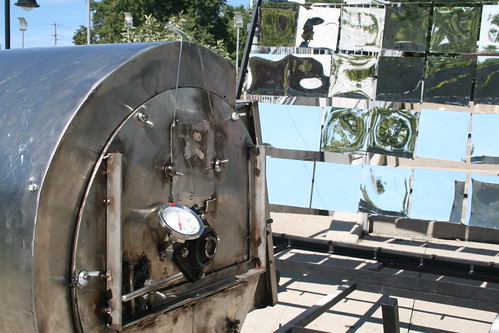
Chocosol Solar Roaster
  • Welcome speech by local MPP Laurel Broten who travelled the province as Minister of the Environment (2005-2007) in support of the legislative and committee process that introduced the Green Energy and Green Economy Act to Ontario;
  • A prototype solar roaster built by Lorin Symington and the Chocosol team used to roast cacao beans for onsite sampling;
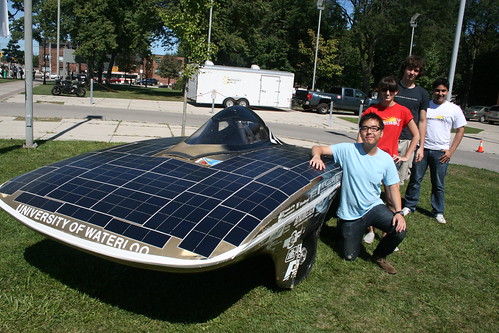
  • The University of Waterloo's Midnight Sun Solar Race Team with last year's solar car used for competing in international solar car competitions;
  • Local business owner Jim McNeil explaining why he decided to make Canclone Services the first solar-powered printer in Toronto; 
  • Information from speaker Matthew Zipchen about the recently launched SolarShare initiative which allows any Ontarian to invest in $1,000 community solar bonds, with a 5-year term and 5% annual return;
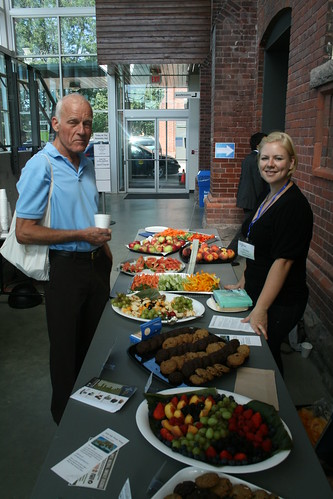
  • Samples of generously donated organic and locally-sourced refreshments from Front Door Organics, The Village Butcher, Fresh City Farms and Social Coffee & Tea Company; 
  • Book signing by author, columnist and Cleanbreak blogger Tyler Hamilton for his new book Mad Like Tesla; and
  • IMG_0251
     University of Waterloo Midnight Sun Solar Race Team
  • Environmental author and speaker Jim Harris delivering the end-of-day keynote speech that explained how going green is good for business.
The Fair encouraged people who not only care about reducing their environmental footprint to gather and discuss ideas, but also those people interested in learning about how to benefit financially from taking on green initiatives. Attendees were able to check out seminars on topics such as rooftop solar technology, community power, green careers and energy conservation through landscaping. Exhibitors provided insight into their sustainable food options, solar technology, and community capacity building.

IMG_0235
The donated delectables.

Even though Ontario has implemented the Green Energy and Green Economy Act, not all communities have easy access to the knowledge and tools required to participate in this emerging sustainable economy. The event was designed to bring useful information to businesses, residents and community groups who are normally quite busy and don’t necessarily have the time to research how they can participate in the province’s emerging green economy.

The Fair was an example of community spirit, created and planned with the participation of local business associations, dedicated volunteers and non-profit community groups who share a passion for a cleaner, healthier and prosperous future.

Key support for the event was provided from the local BIAs, TABIA, Bullfrog Power and Toronto Hydro.
IMG_0260
Event sponsor Toronto Hydro with materials promoting energy efficiency.

Monday, August 15, 2011

Wakulat|Law Organizes 2nd Annual Solar & Conservation Fair on the Lakeshore

Following on the heels of last year's first go-round with the Solar & Conservation Fair on the Lakeshore, Wakulat|Law has become involved in organizing a second iteration of the event.  On Saturday September 10, 2011, the 2nd Annual Solar and Conservation Fair will be hosted by the local Lakeshore Business Improvement Areas. It will take place at the Assembly Hall in South Etobicoke from 11 am to 4 pm. This one-day community event will feature exhibitors, vendors and speakers on topics related to renewable energy, conservation and environmental sustainability. The event is open to residents and businesses. Admission is free.

The Fair is an opportunity for people who not only care about reducing their environmental footprint, but also want to learn how to benefit financially from taking on green initiatives. Last year, the emphasis of the Fair was on solar education. This year it is expanding in scope to meet the broader interests and needs of the community. Attendees can go to seminars on topics such as residential rooftop solar technology and community power, speak to exhibitors who are providing sustainable food options and solar technology, find out about green career opportunities, sample locally-sourced refreshments and learn how to build a community power project.

Not all communities have easy access to the knowledge and tools required to participate in this emerging sustainable economy. Small business owners and residents are busy and don’t necessarily have the time to research how they can participate in the province’s emerging green economy. This type of event is designed to bring them that information and make it more accessible to businesses, residents and community groups.

The Fair itself is an example of community spirit, created and planned with the participation of local business associations, dedicated volunteers from the LAMP Community Health Centre and non-profit community groups who share a passion for a cleaner, healthier and prosperous future. It offers members of the community the opportunity not only to learn about alternative energy from industry leaders, but also from each other. The Fair will also help the local economy by featuring several local business, giving residents the opportunity to directly support their neighbourhood business owners.

This project has received funding support from the Ontario Power Authority through the Community Energy Partnerships Program. Such support does not indicate endorsement by the OPA or the Province of Ontario of the contents of this material. The views expressed in the material are the views of the Recipient and do not necessarily reflect those of the OPA or the Province of Ontario.

Sunday, June 19, 2011

The Changing Landscape of Ontario

I recently had the pleasure of traveling across parts of beautiful southwestern Ontario on a couple of road trips. With the cooperation of some incredible early summer weather, I began to finally see the impact of the province's push to build a distributed and green energy grid. While there is still a ways to go before this area is mistaken for the German countryside, there has clearly been a shift in the level of interest in renewable energy generation.

My first excursion was a round-tripper from Toronto to Port Elgin via Orangeville.  The Canadian Autoworkers union was hosting a retreat for the bi-annual environment conference of its Health and Safety Department. The conference, held at the incredible CAW family education centre on the shores of Lake Huron, was attended by workers represented by CAW locals. You can learn more about their environment programme, by reviewing their statement of principles  and checking out their website. 

This leg of the trip exposed me to a number of wind and solar PV installations, increasing in frequency the closer I was to Port Elgin. There were smaller wind farms along the way culminating in a large collection just south of town. The solar installations alternated between ground-mounted dual-axis tracking installations, fixed ground-mounts and much larger custom-built barns to support large micro-FIT rooftop solar.

My next excursion was a lively affair with the ZooShare Biogas Cooperative team to learn about anaerobic digestion in the Niagara region. Vandermeer Greenhouses began in 1976 after Peter Vandermeer had sold his share of a greenhouse business in Holland and emigrated to Canada with his wife and daughter. Two years later, he purchased 5 acres in Niagara-on-the-Lake and started building. Operations slowly expanded over the years eventually reaching 280,000 square feet and becoming the largest grower of cut mums in Ontario.

Primary and secondary digesters w greenhouse in background.
In addition to becoming a greenhouse leader, the Vandermeers were attuned to other ways they could improve their operations. This led them to research and develop an anaerobic digestion installation. It consists of primary and secondary digesters that are 18 m in diameter and 6 m high; a digestate storage container; an engine producing 335 kW of electricity fed into the provincial grid and 402 kW of thermal heat used in the greenhouse.

The digesters are fed grape pumice from local vintners, expired dog food from a dog food supplier in Guelph, Ontario, rotting or otherwise deficient produce from local farmers and coffee grind from a nearby Tim Hortons. In return, Vandermeer produces electricity and heat and digestate that can be used as an organic fertilizer for local farmers or the greenhouse.


However, proponents of green energy should not assume that this transformation is deep rooted. There are still a number of concerns and issues that must be addressed to assuage a variety of groups (including possibly the next government of the province) before the Green Energy and Green Economy Act will grow as sturdy as a mature oak tree.  Evidence of this discontent was also visible during my travels.

Hopefully, Ontarians will arrive at a solution to the development of green energy that will allow for interested developers and generators to reap the rewards for taking on significant risks but will also allow for the civil resolution of concerns expressed by neighbours and communities. Ontario has an opportunity to lead the way in North America and many residents have already opened the door to that opportunity.

Tuesday, April 5, 2011

Partners in Project Green Discusses Economics of Rooftop Solar

As mentioned in an earlier post, Wakulat|Law worked with Zizzo Allan Climate Law to co-author a report entitled Barriers to the Adoption of Rooftop Solar for Partners in Project Green which is a project being operated in the Pearson Eco-Business Zone.

PPG comprises approximately 12,000 hectares in the Greater Toronto Are, including Toronto Pearson International Airport as well as portions of the Region of Peel, City of Toronto, City of Mississauga and City of Brampton. More than 12,500 primarily small and medium-sized businesses employing over 350,000 people call the Zone home. PPG's main objective is to improve these business' financial and environmental performance through more efficient resource use.

The scale of potential savings in the Zone is significant. An assessment of the current energy-use in the Pearson Eco-Business Zone was completed. A 2007 annual assessment reviewed all non-process energy requirements, which were estimated at 5,801,000 MWh of total electricity consumption and 46,447,000 GJ in natural gas consumption in 2007.

Since the solar barrier report's publication in May 2010, PPG has aggressively worked with its stakeholders to advance the Zone's understanding of Ontario's green energy regulatory framework and the opportunities and risks of implementing rooftop solar photovoltaic projects.

This past March PPG brought together a number of local businesses to further delve into these issues. The sessions included an overview of the Ontario Feed-in Tariff program and approval process for renewable energy projects, along with identifying technical considerations that could impact the economics of rooftop solar projects. A few project proponents also shared their experiences with installing rooftop and ground-mounted solar installations at their facilities.

The following presentations are now available for viewing on the Partners in Project Green website:
~ Rob

Sunday, April 3, 2011

Absence, Explained

Hi Friendly Folks,

As with any amateur blogger worthy of that moniker, I have let ye olde blog slip over the past couple months. The first half of that absence can be easily explained, while the second half is probably best chalked up to simple inertia.

Wildebeest Camp - Solar Umbrella
What is this "absence" I speak of? Well, it starts off with someone very near and dear to me venturing off to Arusha, Tanzania to assist with the prosecution of alleged genocidaires at the United Nation's International Criminal Tribunal for Rwanda during a five-week internship. As I am easily persuaded to venture to far off places, I enthusiastically jumped at the opportunity to spend a few weeks in East Africa at the tail end of this internship.

The journey had an auspicious start as I found myself staying at the serene and friendly Wildebeest Camp in Nairobi. The camp's use of miniature solar panels to power both their indoor and outdoor lighting fit nicely with the camp's overall approach to reduce, recycle, and reuse their local resources.

Wildebeest Camp - Indoor Solar Lighting
Following a restful start to the trip, I took the overland 6-hour bus ride to Arusha, enjoyed my first African border crossing and arrived just as the nighttime ban on bus transport descended on Tanzania. Over the next few days, I took in a couple of trials at the ICTR, including one of a prominent member of the National Republican Movement for Democracy and Development which was the ruling political party of Rwanda from 1975 to 1994. Sobering stuff but heartening to see the international community working towards justice for the victims.

The fruits of deep-sea fishing adventure: calamari!
After a botched attempt at a Rwandan trip, due to the recently implemented visa requirements for Canadians in late 2010, it was decided that attacking the Indian Ocean coast with vim and vigour would be the new itinerary. Snorkeling, medium-sea fishing and general beach merriment was enjoyed thanks to the hospitality of the Peponi Beach Resort (for sale, fyi) and their neighbours. Having enjoyed the ocean so much, it was only natural that instead of heading for Dar and its modern docks and ferries, an attempt would be made to take a 15-foot wooden boat from Pangani to northern Zanzibar.  Gilligan had nothing on this 4-hour-ish tour. How our crew of two navigated sans GPS, compass, sextent or shorelines is beyond me. 

Cafe in Stone Town
Somehow despite getting down to the emergency 15 hp emergency outboard for the last 40 minutes of the voyage, we arrived with our wobbly sea legs on Nungwi's beaches. The extensive resort development was in stark contrast to the minimally-intrusive development on the mainland. Happily, great care is taken by the scuba outfits at Mnemba Atoll to minimize human impacts. The highlight of Zanzibar was a spiced cuppa in Stone Town. The first cafe in Toronto to put Zanzibar-spiced on their menu will have a customer for life!

Finally, it was time for the main invent: a seven-day Kilimanjaro trek! An incredible team of 17 (guides, cooks and porters) accompanied four wide-eyed muzungu up Machame Route. We enjoyed an incredible stretch of gorgeous weather spoiled by about 15 minutes of rain/hail on Day 3. Otherwise the main challenges were acclimatizing to the altitude and protecting the knees of some steep descents. The former won the battle on summit night (departure from base camp at midnight) somewhere above 5400 m. At 3:00 a.m. with no end in sight to a pounding headache, I pulled the chute and made for base camp. Fifty percent of our party made Kibo peak but had to turn around as quick as they came.  The wind, cold and constant sand in the nostrils did little to make that part of the trek enjoyable. Nevertheless, I wouldn't trade the experience for anything.

Kilimanjaro, Kibo Peak
Having slowly readjusted to home life and catching up with local energy news, you can expect me to start blogging with a little more spring in my step. Thanks for your patience and indulgence, everyone! I look forward to reconnecting soon.

~Rob

Kili Breakfast
Peponi Beach Resort

Tuesday, November 2, 2010

Ontario's Solar Incentive Cutbacks: FITting in the Bigger Picture

Earlier this year, the provincial Government of Ontario came under heated criticism when its industry regulator, the Ontario Power Authority, abruptly proposed a rate cut to its microFIT (Feed-in Tariff) program. Coming just nine months after the program launch, the proposal was to scale back the tariff rate for ground-mounted solar PV installations from 80.2 cents per kWh to 58.8 cents per kWh. After a month-long consultation process in which industry proponents argued vociferously against the move, the Ontario Power Authority compromised and settled on a rate of 64.2 cents per kWh while essentially banning the practice of commercial aggregation under microFIT.  

There was considerable concern that the OPA's process as opposed to the actual decision could serve to  undermine investor confidence in the province's much-larger FIT program designed for big producers of energy from sources like the sun and wind. However, it is interesting to note that the OPA decision fits a wider trend affecting FIT programs on a global scale. Presumably still recovering from the Great Recession, many other governments have also reconsidered their financial commitment to renewable energy generation.  Some in a much less adroit manner than Ontario.  For example:
  • Germany:  Both the leading exemplar of how to develop a FIT program and also perhaps how to make effective adjustments on the fly, the government is teaching the German solar industry how to adapt to a much less lucrative home jurisdiction. Following an intense political debate, the German Bundestag decided to invoke a mid-year reduction to its solar FIT program. By early July politicians had agreed on a two-step reduction, with reductions taking place on July 1 and October 1, 2010. For a comprehensive summary of the changes check out the very thorough German Energy Blog.
  • Australia:  At the other end of the competency spectrum, we have the state Government of New South Wales (NSW). Overnight and without warning, NSW slashed its rates from the highest to the lowest in the country. The NSW Solar Bonus Scheme was introduced via legislation in 2009 and provided a FIT tariff rate of 60 cents (Australian) per kWh but starting October 28 is only offering 20 cents per kWh. Similar to the OPA, NSW found its program to be more popular than it anticipated and felt it needed to rein in its long-term financial obligation to renewable energy generation. And like Ontario, local industry has been in an uproar, suggesting the change will eliminate jobs and investments.
  • Spain:  On an even more serious note, the Spanish Energy Ministry has initiated a probe of over 9,000 cases with an eye to any potential fraud by proponents. It has already forced a new deal on 907 installations requiring that they accept 32 euro cents per kWh instead of the 46 euro cents to which they were originally entitled.
  • Italy:  In another sobering situation that goes beyond solar, the Italian government has become involved in embezzlement investigations of alleged criminal organizations that have attempted to take advantage of various renewable incentive programs. 
Abengoa Solar Platform, Sanlúcar la Mayor, Sevilla (Photo by me!)
Despite all this seeming gloom, there is at least one international bright light for solar proponents. The penny-pinching coalition government in the United Kingdom announced a couple a weeks ago that it would improve the efficiency of its solar FIT rates at the next formal review. An attempt will be made to refocus tariffs on the most cost-effective technologies in 2014-15.  Leave it to the Brits to be true to their word.

One last point on the issue of FIT cuts is that proponents should keep in mind that these programs are actually designed to embed rate cuts at predictable intervals. The point of these programs is to provide the boost needed to get renewable technologies to be cost competitive with more established, but dirtier, energy options. As industry moves along their cost curves, the idea is to pass the savings on to the broader market and not have industry capture excessive returns. The question at this point is how best to provide predictability and incorporate public consultation into this decision-making process.  The partial answer in Ontario has been to create an Advisory Panel for the microFIT program which will hopefully ensure smoother price transitions in the future.

Without a doubt, there will be further incentive cutbacks as FIT jurisdictions adjust to the market responses they experience. Ontario appears to be safely applying a middle-of-the-pack approach to its adjustment process, but there is hope that it is starting to work towards being an international leader in working and communicating with its stakeholders.

Keep smiling,
~Rob

    Friday, October 1, 2010

    Wakulat | Law in Local Media

    SNAP Etobicoke, a free community-based publication, recently published a piece highlighting September's Solar & Conservation Fair on the Lakeshore. SNAP wrote:

    Source:  SNAP Etobicoke; Photographer Jerry Lem
    Visitors came armed with tons of questions and left with a wealth of information. Experts like Ken Traynor and John Scheffer discussed residential issues while Travis Allan, Scott McLorie, Robert Wakulat, Osman Sediqi and Roberto Garcia discussed commercial applications. Participants enjoyed the various seminars designed to educate, promote, and encourage solar use and conservation. Afterward the smell of sausages cooking on the solar cooker welcomed them outside where commercial vendors were set up to discuss how to install solar solutions in their homes.

    I established Wakulat | Law with the express purpose of working with community groups, local businesses and individuals after recognizing the lack of willpower at the international level to address important issues such as climate change. Attending the United Nations Framework Convention on Climate Change in Copenhagen last year made me realize how important it is to work towards more sustainable living at local and regional levels. Moreover, local initiatives are likely to have greater community buy-in and achieve longer term success than top-down edicts from federal or international bodies.

    Recently, famous climate change journalist George Monbiot, writing in the UK's Guardian newspaper and his own blog declared the global climate change process to be dead. He has called for a conversation to start on how we can work towards a low-carbon future in a post-Kyoto world.  I believe it starts at home at the dinner table and moves out into our communities from there.

    Sunny days,
    ~Rob

    Tuesday, September 21, 2010

    The Solar Access Issue: Will You Get Burned?

    Update:  This blog entry was recently featured on Toronto Star reporter Tyler Hamilton's blog Clean Break:  www.cleanbreak.ca.  Tyler writes a weekly column of the same name that discusses trends, happenings and innovators in the clean technology and green energy market.

    Having drawn widespread comparisons to a gold rush, Ontario’s welcoming market for solar photovoltaic (PV) investments under its year-old Feed-In Tariff (FIT) program has prompted a race among solar developers to secure commercial rooftops across the province. The FIT program is widely regarded as providing the most lucrative incentive to generate electricity in the world. The Government of Ontario has committed to paying up to 80.2 cents per kilowatt-hour (kWh) for electricity generated by solar rooftop systems under guaranteed 20-year power purchase agreements. This compares quite favorably to the price of electricity sold to the end-user, which can dip as low as 5.3 cents per kWh during off-peak hours.

    Simultaneously, cities across Ontario are incorporating infill development as a significant part of their smart urban growth programs. It’s almost certain these two green trends will eventually experience an increased degree of friction as they continue to rollout across the province’s urban landscapes. In fact, the issue has already attracted media attention in non-PV contexts:

    • in Toronto, a local restaurateur found his home severely shaded by a neighbouring infill project that was eventually resolved with the developer’s offer to install a solar-thermal unit that would replace 50-60% of the annual energy used to heat hot water in the home1; and
    • an Ottawa homeowner who employed a solar “architect” to incorporate passive solar heating for the home is now under threat from a nearby five-storey condo development2.

    Although the former situation resulted in a happy ending, both stories are cautionary tales for aspiring solar electricity generators, adopters of solar water heaters, and anyone else considering more passive solar heating options. As homeowners, businesses and communities are increasingly drawn to these technologies, protecting one’s sunlight will transform from a mere aesthetic concern to an important economic one.

    Solar access has been defined as “the ability to have uninterrupted direct rays of sunlight fall onto one’s property.” A “right to light” would be a legally enforceable right to access a natural and unobstructed flow of solar light. There is currently no “right to light” for Canadian property owners.

    Typical legal advice to more commercially oriented rooftop solar generators includes ensuring that their solar lease incorporates covenants from the landlord that it will not take or permit any action which would block or otherwise interfere with light reaching the solar PV array. In addition, a solar lease will also need to address the tenant’s right to terminate if at some point something happens which impairs the availability of sunlight or otherwise prevents the tenant from operating its facility. However, these provisions do not address the root cause of the problem – a lack of an effective and predictable solar access policy framework in Ontario.

    Canadian courts have not been eager to recognize a right to light. The Ontario Court of Appeal tackled the issue in the 1978 case Earl Putnam Organization Ltd. v MacDonald. A property owner sued its neighbour for constructing an opaque fence directly in front of a window. The plaintiff argued that the fence interrupted the building’s right to light.

    In tossing out the Putnam’s case, the Court of Appeal affirmed that “at common law, there is no natural right to lateral light.” Thus, the court confirmed that property owners enjoy an unrestrained right to build on their land even if their construction will cause shading on neighbouring properties. It has been left up to local politicians and planners to ensure that owners and tenants will not be left in the dark by the encroachment of nearby property developments.

    Fortunately, legal developments have occurred that may provide a small ray of hope to future adopters of solar energy. One such tale involves two solar enthusiasts who nearly had a significant solar investment rendered useless by a condo project at King and Spadina in Toronto. Their case was heard by the Ontario Municipal Board (“OMB”), which had to decide whether a developer’s proposed 14-storey condo would be allowed to cast a shadow on their solar array. The OMB cited the extra two hours of shading on the PV panels for an additional four months as having an adverse impact on the community. It was unequivocal in its disapproval stating, “[a]fter all is said and done this proposal is simply too big; it is too massive; it flies in the face of the … [Toronto Official] Plan; its impacts on surrounding properties are too great.”

    Municipal zoning by-laws and development agreements are, in fact, attuned to the impact of shadows on neighbouring properties and go some way to ensuring that light, view and privacy can be enjoyed by members of the community. As in the situation above, this approach has resulted in right-to-light issues generally coming before a Committee of Adjustment or the OMB on an application to vary the strict provisions of a zoning by-law.

    However, solar proponents considering significant financial investments and 20-year commitments may not be reassured by the “protection” offered by the current regime in Ontario. One option would be for provincial and municipal policymakers to look south and review the panoply of solar access laws that have proliferated in the United States. A number of U.S. jurisdictions have taken it upon themselves to ensure that their property owners can rely on their access to light in order to recoup investments made in solar energy technologies. Until then, it is at least worthwhile reviewing an Official Municipal Plan and local zoning bylaws to determine if your potential solar generator could be left in the dark.

    FUTURE BLOG POST - Let the Sun Shine In: Solar Access Options for Policymakers

    1 http://www.theglobeandmail.com/real-estate/a-green-solution-to-a-neighbours-spat/article1213370/

    2 http://www.ottawacitizen.com/news/hippie+discovers+right+light/3218290/story.html

    Tuesday, September 14, 2010

    Solar & Conservation Fair on the Lakeshore

    On a sunny Saturday, September 11 the Etobicoke Lakeshore community welcomed a group of solar aficionados into their neighbourhood. Wakulat | Law teamed up with the Toronto Renewable Energy Co-Operative, Toronto Hydro, JobStart and the Lakeshore Joint BIA Committee to set up a series of solar 101 seminars and a solar developer exhibition at the beautiful Assembly Hall. Over 120 residents and business owners dropped by the free event to listen to industry experts explain how they could take advantage of Ontario's Feed-in-Tariff programs in order to turn themselves into generators of clean, green energy.

    A video by Ania Kohinski of the CUSW provides a quick overview of the day's events and programming:


    Ken Traynor, Project Manager of the OurPower  program, described the basics of putting up a solar PV installation on a residential roof (click here for presentation). He was accompanied by John Scheffer, Chair of the Lakeshore Village BIA, and newly minted microFIT (<10kW) generator who provided the perspective of someone who has successfully completed a solar PV rooftop project. These gentlemen were greeted with overwhelming enthusiasm as the crowd in their first seminar was standing-room only.  In order to meet the demand of curious residents two residential seminars were held at 1:30 pm and 3:30 pm.

    While residents were peppering their presenters with questions, another group of intrepid solar enthusiasts sought to give the commercial perspective to people representing commercial properties interested in FIT projects (>10 kW).  Travis Allan of Zizzo Allan Climate Law LLP graciously chaired a panel addressing the following topics (click on presenter's name to see presentation):
    While the more studious attendees spent time in the seminars, other fair participants were able to quiz one of the many solar developer exhibitors on system costs, design, technology and timelines. They could also check on their insurance options with the irrepressible Jen Aitchison from Jones Brown Insurance; talk to Toronto Hydro about conservation programs; ask Stephen Clow from JobStart how to find green jobs; learn more about community power from the OSEA team; relax with the sublime organic chocolate samples from ChocoSol's serene Ilian Balicki or sample a solar-cooked stir fry.

    Attendees heard about a positive opportunity to go solar, but were also cautioned to be move methodically through the development of any size solar PV installation.  For commercial property owners interested in more information, it may be helpful to review the Rooftop Solar Study commissioned one year ago by Partners in Project Green.  Rob was a co-author along with Zizzo Allan Climate Law LLP and University of Toronto doctoral candidate Dave Bristow.

    The report studies barriers to implementing rooftop solar in the Pearson Eco-Business Zone surrounding Toronto’s Pearson Airport. The study was published by the Toronto & Region Conservation Authority in May 2010.

    Wakulat | Law would like to thank the following people and organizations for making this event possible:
    • Sponsors: Toronto Hydro, TREC, JobStart and World's Greenest Business Cards.
    • Hosts:  Lakeshore BIA communities
    • Promoters:  CUSW, OSEA, SNAP Etobicoke, Etobicoke Guardian, Toronto Association of Business Improvement Areas, greenTbiz, Franke James (and her Green Conscience)
    • Volunteers:  A dedicated group of young green volunteers interested in promoting a sustainable city and supporting the goals of Wakulat | Law.